

Monday, 28/09/2026, 16:00 (GMT +7)
 5
5
US Shippers Expand Port-to-Inland Connectivity to Diversify Supply Chain Risks
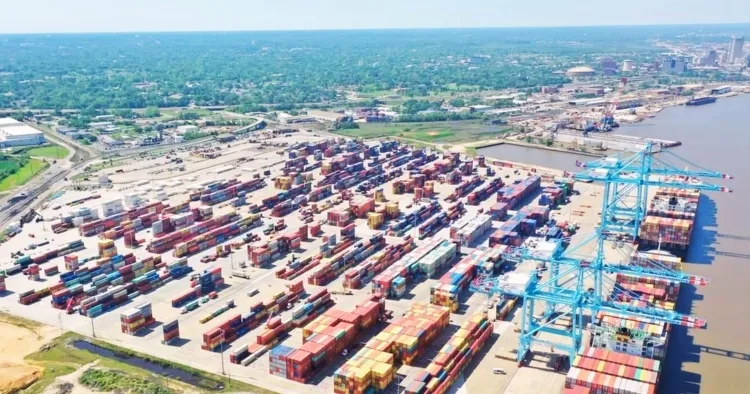
Source: APM Terminals
Maintaining a smooth flow of goods gives shippers greater flexibility in transport planning. According to Brian Harold, Executive Director of APM Terminals Mobile, port-to-inland transit is increasingly being used as a way to improve supply chain resilience.
“I think for shippers what we’re seeing now is more about diversification. They don’t want to put all their eggs in that one basket,” Harold said.
The strategy aims to spread supply chain risks. When cargo depends on a single ocean route or port, any disruption along that route can affect the entire transportation plan.
According to Harold, connections between seaports and inland destinations can help reduce transportation costs, cut down on empty truck miles and make better use of rail capacity, particularly as some ocean freight corridors face disruption and congestion.
Expanding Capacity at the Port of Mobile
At the Port of Mobile in Alabama, APM Terminals currently operates the only container terminal. The facility began operations in 2008, and in 2016, APM Terminals added a rail terminal. Before that, the Mobile area did not have an intermodal rail connection serving port operations.
The port currently handles around 600,000 TEU per year, while its gateway capacity could be expanded to 2.5 million TEU.
“We’re investing a lot of money in the gateway right now, along with the state, deepening and widening the ship channel, and then we’ve expanded the terminal five times within the past 10 years, and invested over a billion dollars,” Harold said.
Reducing Transportation Costs and Empty Truck Miles
One of the benefits of port-to-inland connectivity is the ability to reduce trucking distances. Instead of using trucks for the entire journey, containers can be moved a short distance from the port to an inland connection point and then continue by rail.
This model reduces the number of long-distance truck movements that do not directly contribute to cargo transportation. For example, a truck may have to haul a container 300 miles and then travel another 300 miles to return the chassis. In another case, after delivering a container to its destination, the operator may still have to return the empty container to the port.
“If you can have a shipper that instead of trucking 300 miles each way, can now just have the truck move … about a mile or two to an inland port site, and then the railroad takes it from there, that’s a huge win and usually a very good positive impact to their overall supply chain cost,” Harold said.
When choosing a mode of transport, shippers must weigh the costs of trucking against rail, as well as rail against barge transportation. In addition to direct costs, state-level regulations can also influence the choice of transport.
According to Harold, in some cases, moving overweight cargo by truck can result in fines and additional costs. Hours-of-Service regulations also limit the number of hours drivers are permitted to operate vehicles, affecting the ability to carry out long-distance trucking journeys.
Port of Mobile and the Automotive Supply Chain
Despite having only one container terminal, the Port of Mobile plays an important role in connecting Alabama’s automotive industry, which has an extensive manufacturing and supply network.
An automaker may need to coordinate with numerous Tier 1 and Tier 2 suppliers, involving large cargo volumes and tight delivery schedules. This makes managing cargo flows across the entire supply chain increasingly complex.
“It requires flexibility within a port to really be able to cater to the needs of automotive manufacturers,” Harold said.
For the automotive manufacturing industry, late deliveries can have a direct impact on assembly line operations.
“If a shipper can just basically expedite their cargo when it comes off a vessel within 24 hours to an inland site, right next to their distribution center or their manufacturing center, then that’s a huge plus for the stability of their supply chain,” Harold said.
Advantages of a Class I Rail Network
Connectivity to the Class I railroad network at Mobile also gives shippers additional transportation options.
One example is Canadian National (CN). CN’s network does not connect directly with container ports on the US East and West coasts, but access to Gulf Coast ports provides the railroad with additional opportunities to handle containerized cargo.
According to Harold, when considering capacity on rail corridors connecting to the East and West coasts, utilization levels on these routes are typically high.
“There’s not a lot of additional capacity there on a regular basis. Whereas from the Gulf for containerized cargo, there’s a tremendous amount of capacity available on these rail lines,” he said.
See more:
- China’s Airfreight E-commerce Volumes Fall 16% in August
- SITC updates Vietnam-Intra Asia sailing schedules in Oct 2026
- Two More Oil Tankers Attacked in Strait of Hormuz as Risks Escalate
- Gemini shifts four services - AE5, AE11, AE12 and ME2 - to Suez routings
- International Shipping and Logistics Market Update Week 38/2026 | Phaata
- Container Freight Rates on Asia–US Routes Near Pandemic-Era Peaks
- Maritime Tensions: Iran Attacks Vessel in Hormuz as Italy Prepares Independent Red Sea Escort Plan
- SITC – CONNECTING CAMBODIA WITH VIETNAM AND THE WORLD
- Hapag-Lloyd CEO: Container Shipping Demand Remains Resilient Amid Geopolitical Volatility
- US Container Imports Reach 2.6 Million TEU, Third-Highest Volume on Record
- Prolonged Gulf Crisis Raises Biofouling Risks for Idled Vessels
- COSCO Shipping Heavy Industry Begins A-Share Listing Process in Shanghai
- COSCO schedules: Vietnam - North America in Sep 2026
Source: Phaata.com (According to Supply Chain Dive)
► Find Better Freight Rates & Logistics Service Providers!


Featured News
- Hapag-Lloyd applies Peak Season Surcharge from East Asia to USA and Canada
- The world\'s largest container ships MSC Irina and MSC Loreto floated
- MSC (Mediterranean Shipping Company) - The world\'s leading container shipping lines
- Information you need to know about Maersk Line
- Top 10 export and import goods between Vietnam - Philippines in the first 5 months of 2020

 Market News
See more
_-_Copy.webp)
.webp)

 HOT PROMO
See more
71
 FCL
FCL
 5 Days
 Freight cost

OPL LOGISTICS
340
FCL
2 Days
Freight cost

CÔNG TY TNHH PIO LOGISTICS
1078
FCL
31 Days
Freight cost

CÔNG TY TRÁCH NHIỆM HỮU HẠN DT LOGISTICS (VN)
2142
FCL
30 Days
Freight cost

CÔNG TY TNHH PEGASHIP
3812
FCL
45 Days
Freight cost

Compass Logistics
 Premium
Why do thousands of businesses trust Phaata?
USERS/MONTH
LOGISTICS COMPANIES
REQUEST FOR QUOTEŚ
QUOTATIONS
VIETNAM LOGISTICS COMMUNITY
5 Steps to Get the Best Quote
Find a price quickly/Send a RFQ
Compare multiple options
Contact for Further Consultation
Negotiating prices/services
Management & rating
 Freight rates
Sea freight
- FCL
See more
45
 50
22
Days Direct
50
22
Days Direct
- ₫179,948,400 / 40'RQ

CÔNG TY CỔ PHẦN QUỐC TẾ ANVY
68
13
Days Direct
- ₫75,419,550 / 40'RQ

CÔNG TY TNHH VẬN CHUYỂN QUỐC TẾ RYLOGS
90
35
Days Direct
- ₫195,826,200 / 20'GP
- ₫243,459,600 / 40'GP
- ₫243,459,600 / 40'HQ

CÔNG TY TNHH TIẾP VẬN TOÀN CẦU KM
72
32
Days Transit
- ₫57,371,784 / 20'GP
- ₫110,774,118 / 40'GP
- ₫110,774,118 / 40'HQ

CÔNG TY TNHH GRAND OCEAN LINE VIỆT NAM
Sea freight
- LCL
See more
540
7
Days Direct
- ₫105,852 /cbm

Công ty Cổ phần vận tải xuyên đại dương OVC
3,063
4
Days Direct
- ₫26,463 /cbm

CÔNG TY TNHH IEC EXPRESS (VIỆT NAM)- CHI NHÁNH HÀ NỘI
4,140
5
Days Direct
- ₫26,463 /cbm

CHI NHÁNH TẠI THÀNH PHỐ HỒ CHÍ MINH - CÔNG TY CỔ PHẦN MG LOGISTICS
4,581
8
Days Direct
- Refund ₫2,362,500 /cbm

CÔNG TY CỔ PHẦN TIẾP VẬN INTERCARGO
4,848
4
Days Direct
- ₫26,463 /cbm

CÔNG TY CỔ PHẦN GIAO NHẬN VẬN TẢI MỸ Á (ASL LOGISTICS)
 Air freight
- General cargo
Air freight
- General cargo
See more
1,693
10
Days Transit
- 264,630 ₫/kg

Phoenix Logistics Vietnam - chi nhánh TP. Hồ Chí Minh (Phoenix International Forwarding Vietnam )
2,753
1
Days Direct
- 185,241 ₫/kg

CÔNG TY TNHH THƯƠNG MẠI VÀ DỊCH VỤ FASTRANS
6,104
 5,683
8
Days Transit
5,683
8
Days Transit
- 224,936 ₫/kg

CÔNG TY TNHH SEA GLOBAL VIỆT NAM
3,114
1
Days Direct
- 502,797 ₫/kg

CÔNG TY TNHH VẬN TẢI QUỐC TẾ GIA PHÚ
 Rail freight
- FCL
Rail freight
- FCL
See more
237
3
Days Direct
- ₫15,083,910 / 40'HQ

CÔNG TY CỔ PHẦN VẬN TẢI VÀ THƯƠNG MẠI ĐƯỜNG SẮT
1,594
5
Days Direct
- ₫26,463,000 / 40'HQ
- ₫26,463,000 / 45'HQ

CÔNG TY TNHH PHƯỚC TÁ
11,192
7
Days Direct
- ₫48,956,550 / 20'GP

Công ty TNHH T&M Forwarding
10,436
5
Days Direct
- ₫7,145,010 / 20'GP
ASIAN EXPRESS LINE VIETNAM ( AEL VIET NAM )
8,488
10
Days Direct
- ₫9,262,050 / 20'GP

CÔNG TY CỔ PHẦN LOGISTICS QUỐC TẾ V&T
 Road freight
- FCL
Road freight
- FCL
See more
43,256
1
Day
- ₫6,868,686 / 20'OT
- ₫6,868,686 / 40'OT
- ₫6,868,686 / 40'OT HQ

CÔNG TY TNHH LIÊN VẬN QUỐC TẾ SHINING OCEAN VIỆT NAM
100,978
2
Day
- ₫6,500,000 / 40'RF
- ₫6,500,000 / 40'RQ
- ₫6,500,000 / 45'RQ

CÔNG TY CP PROSHIP
Premium
171,070
1
Day
- ₫18,997,200 / 20'GP
- ₫18,997,200 / 40'GP

CÔNG TY CỔ PHẦN GIAO NHẬN VẬN TẢI CON ONG
263,313
3
Day
- ₫32,000,000 / 20'GP
- ₫64,000,000 / 40'GP
- ₫64,000,000 / 40'HQ
- ₫64,000,000 / 45'HQ

Công ty Cổ phần phát triển thương mại Thuận Đạt Việt Nam
283,686


