


Wednesday, 21/10/2026, 09:48 (GMT +7)
 54
International Shipping and Logistics Market Update Week 42/2026 | Phaata
International shipping and logistics market update - Week 42/2026
Table of Contents
-
World Container Index Week 42/2026
-
Asia - North America Ocean Freight Rates
-
Asia - Europe Ocean Freight Rates
-
Northern America - Asia Ocean Freight Rates
-
Northern Europe - Asia Ocean Freight Rates
-
Conclusions and Recommendations by Phaata
1. World Container Index Week 42/2026
Drewry’s World Container Index (WCI) for Week 42/2026 (from October 12 to October 18, 2026) increased by 3.08% compared to the previous week, reaching $4,485/FEU.
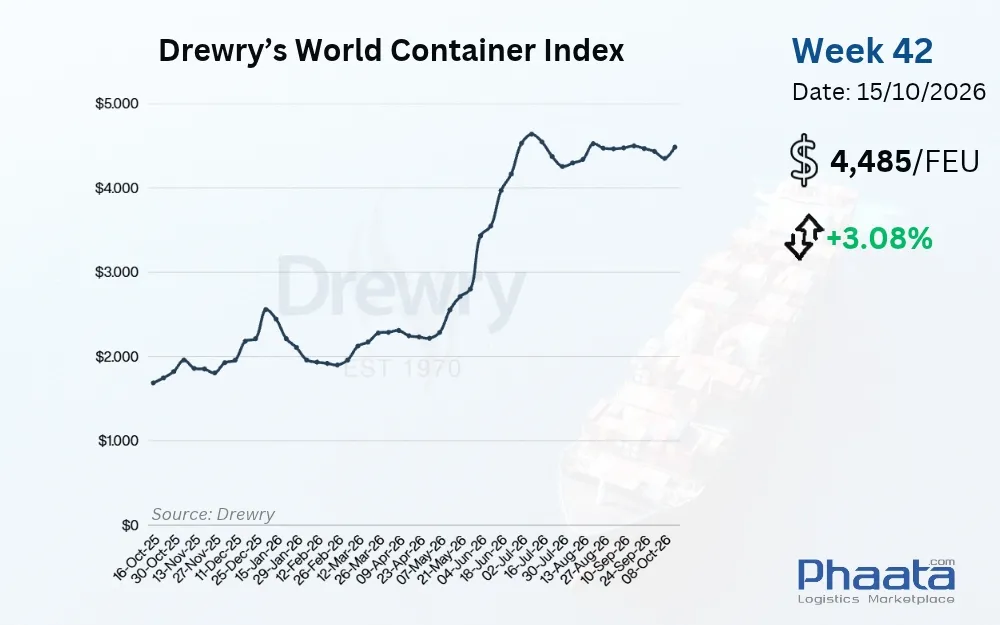
Drewry's World Container Index Week 42/2026 (Photo: Phaata)
2. Asia-North America Ocean Freight Rates
Supply and Demand:
Post-Golden Week Capacity Injections: Following China's Golden Week holiday, operational activities on the trade lane are gradually resuming. Several carriers have begun deploying extra loaders to inject additional transport capacity and clear the post-holiday cargo backlog. The efficacy of this measure will hinge on the scale of deployment and operational conditions at the ports.
U.S. Import Container Volumes Hit Record Highs: Import demand continues to be a standout factor on this route. According to provided data, total U.S. import container volumes in September reached a record high for the month at 2.55 million TEUs; notably, imports from China surged by 21.2% year-over-year (YoY). The Port of Los Angeles also recorded a throughput of over 1 million TEUs for the month. These figures demonstrate that import activity remains highly elevated, though the trajectory in the coming months will depend on market demand and broader trade factors.
Asian Port Schedules Remain a Watchpoint: Persistent vessel delays at select Asian loading ports could continue to impact transit times and cargo receipt planning at destination ports.
Rate Developments:
Ocean freight rates from Asia to the North America West Coast in Week 42/2026 rose slightly by 0.37% week-on-week, settling at $8,322/FEU. This rate is up 5.28% month-on-month, according to Xeneta data.
Spot Rates May Remain Elevated in the Short Term: Following Golden Week, spot rates on the route are showing signs of stalling. Developments in the second half of October will depend on booking demand, cargo backlogs, and carrier operational plans. With import volumes sustaining high levels, the rate baseline is likely to remain supported in the near term. However, pricing trends in the coming months will ultimately depend on supply-demand shifts and capacity adjustment strategies.
Potential Capacity Shifts from the Asia-Europe Trade: The return of certain Asia-Europe services to the Suez Canal routing can shorten vessel turnarounds, thereby facilitating the realignment of vessel and equipment deployment within the operational network. Over the next 2–4 months, if a portion of these freed-up resources is reallocated to the Trans-Pacific Eastbound (TPEB) route, operational capacity could swell ahead of the Lunar New Year peak. The magnitude of this impact will depend on individual carrier redeployment plans and the pace of service network adjustments.
Stay tuned to Phaata International Logistics Marketplace for in-depth and fast market updates.
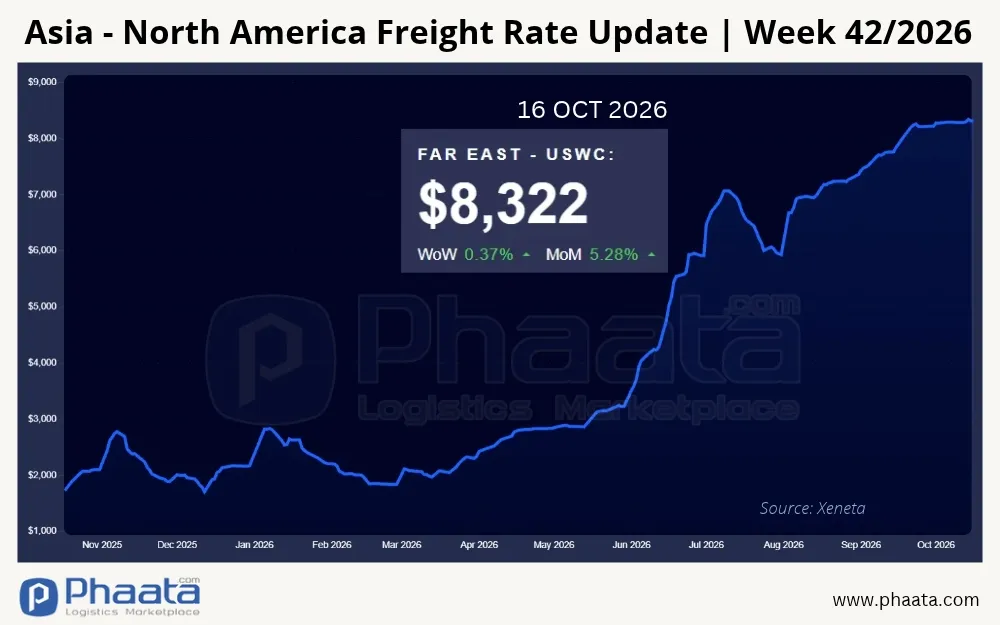
Asia-North America Freight Rates | Week 42/2026 (Photo: Phaata.com)
US Tariff Updates:
1. U.S. Proposes Maritime and Trade Measures Against Spain
FMC Proposes Fees on Spanish-Flagged Vessels: On October 14, 2026, the U.S. Federal Maritime Commission (FMC) announced a proposal to levy a $200,000 fee per port call on Spanish-flagged vessels arriving at U.S. ports, while simultaneously considering import restrictions on specific Spanish commodity groups. This proposal follows an investigation into Spain's refusal to grant port access to certain U.S.-flagged vessels under the Maritime Security Program (MSP) in late 2024, an issue tied to shipments with destinations or origins linked to Israel.
Commodity Groups Under Review: The proposed restricted list includes perfumes and cosmetics; oils and fats; ceramics; stone products; and sugar and confectionery. The exact scope of enforcement will depend on consultation outcomes and subsequent FMC rulings.
Impact on Transport Operations: According to the FMC, the port access dispute has disrupted the operations of MSP vessels in Spain. Several services have had to adjust their routings and utilize alternative transshipment hubs, including Tangier Med in Morocco. These shifts could impact transport orchestration and transit times for related shipments.
Review Timeline: The FMC is currently accepting public comments on the proposed measures, with a submission deadline of December 14, 2026. These proposals do not imply that the supplementary fees or import restrictions are officially in effect yet.
2. U.S. Caps Import Volumes for New IORs on Select Polysilicon Products
Volume Limits on New Importers: According to a notice published on September 24, 2026, certain Importer of Record (IOR) numbers registered with U.S. Customs and Border Protection (CBP) from August 6, 2026, onward are subject to weekly import volume caps for specific polysilicon-related products until December 4, 2026, unless explicitly approved by the Department of Commerce (DOC). The limits are categorized by product group, notably capping solar cells at 2,000 units and solar modules at 55 units per week.
Monitoring Import Volumes: Authorities may review and adjust these limits as necessary to mitigate the risk of inventory stockpiling. The regulation also addresses enforcement against the use of multiple IORs to circumvent these caps.
3. International Postal Declarations: Implementation of Entry Type 13 Delayed
Extended Preparation Window: On October 14, 2026, CBP announced a delay in the mandatory implementation of the new declaration process for international postal shipments, pushing the deadline from October 22, 2026, to January 20, 2027.
Applicable Scope: According to CBP, international postal shipments subject to Section 201, Section 232, or Section 301 tariffs - or those falling under the jurisdiction of federal Partner Government Agencies (PGAs) - must be filed electronically via the Automated Commercial Environment (ACE) system under the Entry Type 13 process if they qualify for informal entry procedures. Shipments that do not qualify may be required to undergo formal entry procedures per standard regulations.
4. U.S.-EU Tariff Agreement: Developments to Monitor
Ongoing Policy Interest: The U.S.-EU trade agreement framework announced in 2025 mandates a 15% tariff on the majority of EU goods falling under the agreement's scope, including automobiles and select industrial goods. Steel and aluminum continue to operate under a separate tariff mechanism. Divergences in trade policy, environmental regulations, and foreign relations are factors that could influence the agreement's execution.
Ukraine Policy and CBAM: Evolving U.S.-Europe relations, including policies regarding Ukraine and the EU's rollout of the Carbon Border Adjustment Mechanism (CBAM), are drawing intense focus within the context of bilateral trade. CBAM could generate additional emissions data requirements and compliance costs for certain goods. However, the specific impact on the tariff agreement remains contingent upon subsequent official decisions and developments.
Tariff Scope: The 15% tariff is not applied uniformly across all products. Actual duty liabilities depend on HS codes, rules of origin, Most Favored Nation (MFN) rates, and sector-specific tariff measures, including those governing steel and aluminum.
Stay tuned to articles on the Phaata International Logistics Marketplace for rapid and in-depth market updates.
3. Asia-Europe Ocean Freight Rates
Supply and Demand:
High Operational Capacity Maintained: In Week 42, carriers continue to maintain high operational capacity on the route. Based on current data, the short-term blank sailing ratio sits at 0%, indicating no sailings have been announced as canceled for this period.
Capacity Adjustment Plans for November: Blank sailing ratios are projected to climb in the coming weeks, rising from 3.6% in the week commencing October 19, to 6.6% the week of November 2, and reaching 13.9% the week of November 9. However, as carriers are actively updating their schedules, actual cancellation rates may fluctuate from current projections.
Suez Canal Rerouting Dynamics:
Suez Transits on the Rise: Container shipping activity via the Suez Canal is flashing signs of recovery. For the week ending October 4, container vessel transits through the canal reached 61, a staggering 154% YoY increase according to provided data. This trend indicates that several services are gradually returning to the Suez routing, although the pace of recovery varies among carriers.
Security and Insurance Risks Remain Critical: The security situation in the Red Sea remains a paramount factor influencing routing decisions. War risk insurance conditions - including the feasibility of securing coverage on short notice - can heavily impact shippers' transport planning.
Potential for Shorter Transit Times: For services that have reverted to the Suez Canal routing, transit times can be significantly reduced compared to the Cape of Good Hope detour. Nevertheless, actual time savings will depend on the specific itinerary, operational schedules, and the overall performance of individual services.
Freight Rate Developments:
Ocean freight rates from Asia to Europe in Week 42/2026 decreased by 2.02% week-on-week, settling at $3,439/FEU. This rate is down 14.50% month-on-month, according to Xeneta data.
Spot Rates Flash Signs of Recovery: The Shanghai Containerized Freight Index (SCFI) on the Asia - North Europe route rebounded after 13 consecutive weeks of decline. Anticipated capacity adjustments in the coming period could help sustain the rate baseline. Regardless, price trajectories will continue to hinge on transport demand, capacity supply, and carriers' execution of planned blank sailings.
Stay tuned to Phaata International Logistics Marketplace for in-depth and fast market updates.
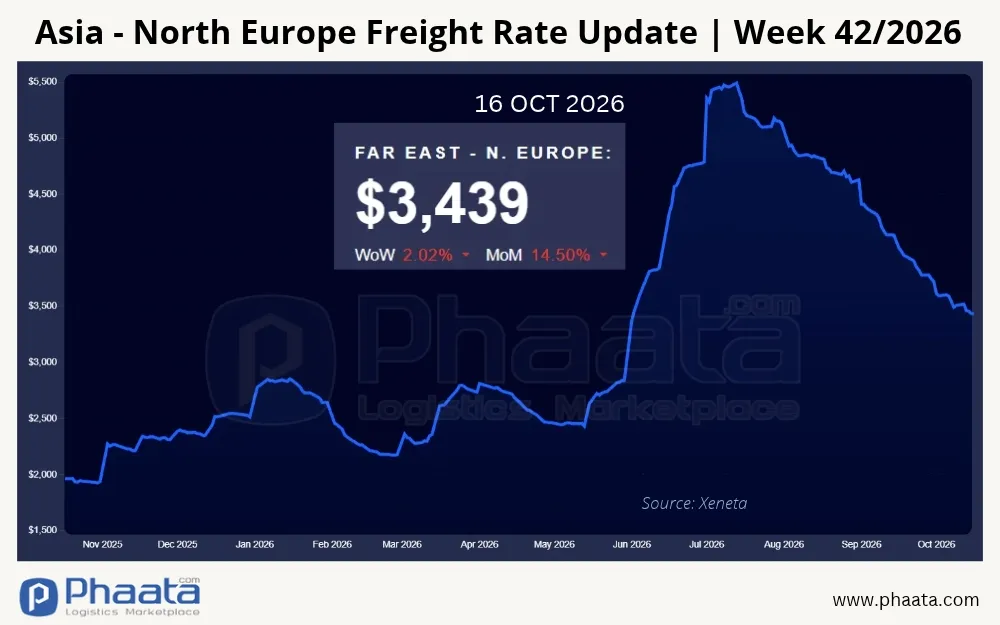
Asia-Europe Freight Rates | Week 42/2026 (Photo: Phaata.com)
4. North America - Asia Ocean Freight Rates
Ocean freight rates from North America (West Coast) to Asia in Week 42/2026 increased by 2.38% week-on-week, reaching $688/FEU. This rate is down 1.71% month-on-month, according to Xeneta data.
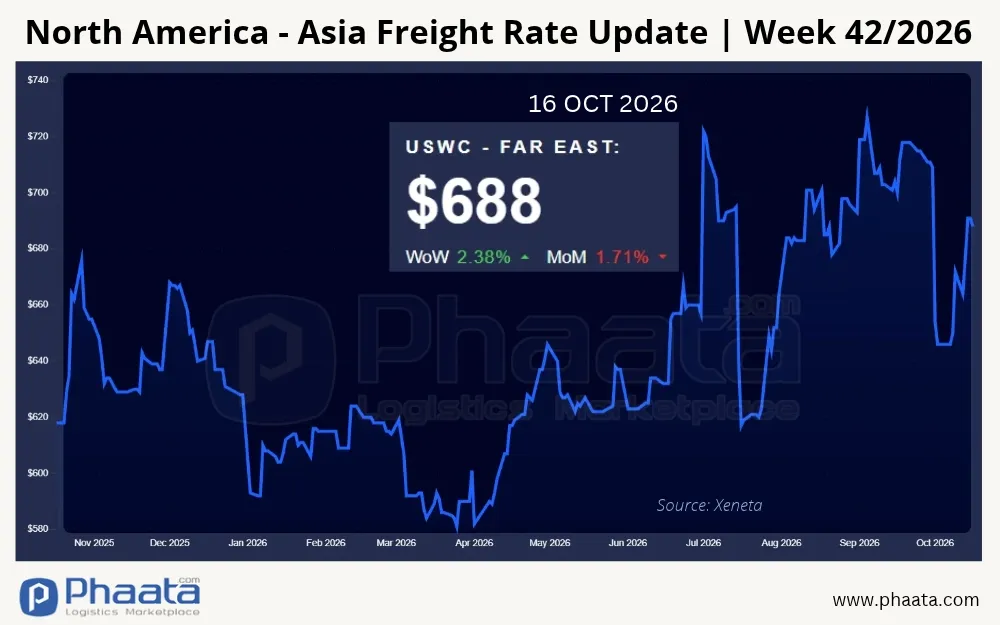
North America (West Coast) - Asia freight rates | Week 42/2026 (Photo: Phaata.com)
5. Northern Europe - Asia Ocean Freight Rates
Ocean freight rates from North Europe to Asia in Week 42/2026 increased by 3.43% week-on-week, settling at $241/FEU. This rate is up 1.69% month-on-month, per Xeneta data.
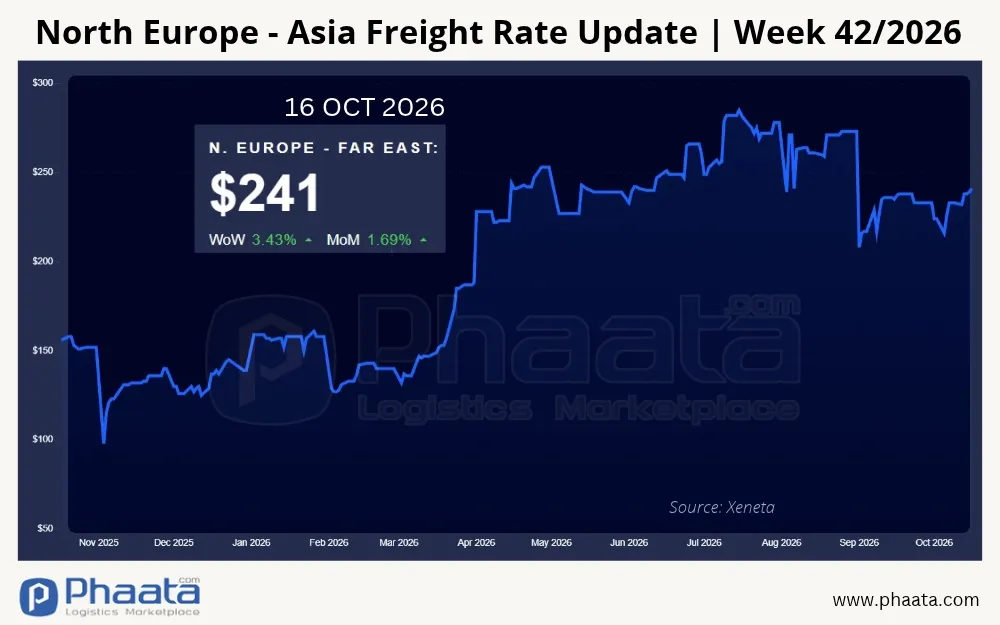
Container Freight rates from Northern Europe to Asia | Week 42/2026 (Photo: Phaata.com)
6. Conclusion and Recommendations from Phaata
In Week 42/2026, the WCI index ticked up 3.08% to $4,485/FEU, signaling a potential recovery in spot container freight rates. Trends across major trade lanes continue to diverge, while shifts in sailing schedules, Suez Canal routings, and U.S. trade policies remain pivotal watchpoints for import-export and logistics enterprises.
Trans-Pacific Route (Asia - North America): U.S. import container volumes remain exceptionally high. According to provided data, September imports hit 2.55 million TEUs, with Chinese-origin cargo jumping 21.2% YoY; the Port of Los Angeles handled over 1 million TEUs for the month. Post-Golden Week, several carriers are deploying Extra Loaders to inject capacity and clear backlogs. USWC spot rates were recorded at $8,322/FEU. Moving forward, businesses should continue monitoring vessel delays at Asian loading ports, as these could impact transit times and receiving schedules during the year-end peak season.
Far East - West Europe Route: The SCFI on the Asia - North Europe route bounced back after 13 straight weeks of decline, while Xeneta data recorded rates at $3,439/FEU. Carriers plan to adjust capacity in November, with blank sailings potentially hitting 13.9% during the week of November 9. These changes could sway operational capacity and rate baselines in the ensuing weeks. Concurrently, container vessel traffic through the Suez Canal spiked 154% YoY, reaching 61 transits during the reported week. The return of certain services to the Suez could shorten transit times. However, Red Sea security conditions and the complexities of securing war risk insurance must be carefully weighed when selecting transport routes.
U.S. Trade Policy and Customs Procedures:
-
FMC Proposal Regarding Spain: The Federal Maritime Commission (FMC) has proposed a $200,000 fee per port call for Spanish-flagged vessels and is reviewing import restrictions on certain commodity groups. As this is currently a proposal and not an enacted ruling, the actual impact will depend on consultation outcomes and subsequent regulatory steps.
-
Import Limits on Polysilicon Products: Regulations capping weekly import volumes for certain new Importer of Record (IOR) numbers represent a critical compliance point in the solar energy sector.
-
Entry Type 13 Implementation Extension: Pushing the mandatory rollout date to January 20, 2027, provides stakeholders with critical buffer time to audit international postal declaration workflows, perfect documentation, and ready systems for CBP requirements.
-
U.S.-EU Tariff Agreement: The 15% tariff applied to the majority of goods under the agreement is a vital factor to incorporate into import cost planning. Developments regarding trade policies and the EU's CBAM should be monitored to assess emerging shifts in costs and compliance mandates.
Recommendations from Phaata
Booking Planning and Schedule Management:
North America Route: For shipments slated to be ready in the latter half of October and throughout November, businesses should strategically time their bookings to align with delivery plans, especially for cargo with rigid deadlines. Given sky-high import volumes and fluctuating schedules at Asian ports, securing confirmed space and departure dates will streamline transport coordination. For U.S.-bound cargo, incorporating buffer time for ocean transit and inland distribution should also be considered based on the specific route, cargo profile, and delivery requirements.
Far East - West Europe Route: Ahead of planned capacity cuts in November, businesses should consult with carriers or forwarders regarding operational schedules and the feasibility of securing space on suitable sailings. For shipments with fixed delivery schedules, booking early and tracking vessel itineraries will provide shippers with greater agility should sailings be altered. For Suez-routed services, businesses must explicitly confirm the intended routing, estimated transit times, and related insurance conditions before selecting the option.
Monitor Trade Policies and Prepare Customs Documentation:
Goods Originating from Spain: Importers dealing with commodity groups potentially falling under the FMC's proposal should track the consultation progress and assess their reliance on Spanish sourcing. Depending on how the situation unfolds, businesses may need to discuss alternative transport or sourcing options with suppliers and logistics partners. Companies interested in submitting public comments can refer to the FMC's guidelines and deadline, currently set for December 14, 2026.
Polysilicon-Related Products: Importers of solar cells and modules should review their applicable caps based on their IOR and product group before planning upcoming shipments. If a shipment is likely to exceed the limit or fails to meet import conditions, businesses should consult their customs brokers regarding viable solutions, which may include holding goods in a bonded warehouse if permitted under current regulations. For over-limit import needs, businesses should familiarize themselves with the DOC approval procedures and the required documentation.
International Postal Declarations (Entry Type 13): The extension period through January 20, 2027, should be utilized to audit international postal product portfolios, identify items ineligible for informal entry procedures, and determine the appropriate declaration method on the ACE system. Engaging with courier services and customs brokers during this preparatory phase will help businesses align workflows with the new requirements and prevent unwanted disruptions.
Goods Imported from the EU: For EU imports, businesses should continue tracking tax policies by specific HS code and the precise scope of the agreement, rather than assuming a blanket 15% tariff applies universally to all items. Updating cost scenarios and CBAM-related compliance requirements for affected commodity groups will assist businesses in accurately projecting landed costs and refining supply plans accordingly.
Stay tuned to articles on Phaata.com or Phaata fanpage for rapid and in-depth market updates.
Find Freight Rates Here
Find Logistics Companies Here
See more:
- Hapag-Lloyd to Adjust Six Asia–Europe Services Under Gemini Cooperation from November 2026
- Port of Rotterdam Container Throughput Remains Nearly Flat as Transshipment Volumes Fall 20%
- Strait of Hormuz Sees Further Attacks as Two Commercial Vessels Sink
- Port of Oakland Signals Recovery as September Container Throughput Rises 5.4%
- Mega-Container Vessels Return to the Suez Canal Despite Persistent Red Sea Risks
- Ship Recycling Activity Drops to More Than 50-Year Low as Global Fleet Faces Rapid Aging
- ClarkSea Index Sets Fifth Consecutive Record as Daily Vessel Earnings Reach $84,951
- Ocean Shipping Disruptions and Tariff Uncertainties Drive Incremental Air Freight Demand in Q4
- MSC and ONE to Continue Ipanema Service Under New VSA from April 2027
- COSCO SHIPPING Holdings Expands Asia-Pacific Service Network
- COSCO updates Vietnam-Intra Asia sailing schedules in Oct 2026
- Around 12% of Global Containership Capacity Affected by Port Congestion
- CMA CGM Completes $1.4 Billion Acquisition of FedEx Supply Chain
- COSCO schedules: Vietnam - North America in Oct 2026
- COSCO updates Vietnam-North Europe sailing schedules in Oct 2026
- SITC updates Vietnam-Intra Asia sailing schedules in Oct 2026
Source: Phaata - Where Shippers & Logistics Providers Connect
► Find Better Freight Rates & Logistics Service Providers!


Featured News
- Hapag-Lloyd applies Peak Season Surcharge from East Asia to USA and Canada
- The world\'s largest container ships MSC Irina and MSC Loreto floated
- MSC (Mediterranean Shipping Company) - The world\'s leading container shipping lines
- Information you need to know about Maersk Line
- Top 10 export and import goods between Vietnam - Philippines in the first 5 months of 2020

 Market News
See more



 HOT PROMO
See more
637
 FCL
 6 Days
 Freight cost

CÔNG TY CỔ PHẦN TIẾP VẬN INTERCARGO
1405
FCL
5 Days
Freight cost

CÔNG TY TNHH VẬN CHUYỂN QUỐC TẾ N.B.L
3059
FCL
20 Days
Freight cost

N.B.L INTERNATIONAL TRANSPORT CO., LTD
4573
FCL
21 Days
Freight cost
MG LOGISTICS JSC
5815
FCL
28 Days
Freight cost

CÔNG TY TRÁCH NHIỆM HỮU HẠN DT LOGISTICS (VN)
Why do thousands of businesses trust Phaata?
USERS/MONTH
LOGISTICS COMPANIES
REQUEST FOR QUOTEŚ
QUOTATIONS
VIETNAM LOGISTICS COMMUNITY
5 Steps to Get the Best Quote
Find a price quickly/Send a RFQ
Compare multiple options
Contact for Further Consultation
Negotiating prices/services
Management & rating
 Freight rates
Sea freight
- FCL
See more
152
35
Days Transit
- ₫122,391,375 / 20'GP
- ₫154,146,975 / 40'GP
- ₫154,146,975 / 40'HQ

GIA LINH LOGISTICS SERVICES CO., LTD. (G LINK Logistics)
383
 615
56
Days Transit
- ₫187,887,300 / 20'GP
- ₫234,462,180 / 40'GP
- ₫234,462,180 / 40'HQ

CÔNG TY TNHH TIẾP VẬN TOÀN CẦU KM
602
5
Days Direct
- ₫16,312,500 / 20'GP
CÔNG TY CỔ PHẦN TIẾP VẬN INTERCARGO
1,402
7
Days Direct
- ₫23,816,700 / 20'GP
- ₫39,694,500 / 40'GP
CÔNG TY TNHH VẬN CHUYỂN QUỐC TẾ N.B.L
Sea freight
- LCL
See more
670
 1,275
5
Days Direct
- ₫26,463 /cbm

CÔNG TY TNHH T&M FORWARDING - CHI NHÁNH HÀ NỘI
2,708
3
Days Direct
- Refund ₫926,205 /cbm

CÔNG TY CỔ PHẦN GIAO NHẬN VẬN TẢI HỒNG SƠN
3,246
3,515
3
Days Direct
- ₫132,315 /cbm
CÔNG TY TRÁCH NHIỆM HỮU HẠN DT LOGISTICS (VN)
 Air freight
- General cargo
See more
3,847
1
Days Direct
- 46,310 ₫/kg
N.B.L INTERNATIONAL TRANSPORT CO., LTD
5,115
1
Days Direct
- 161,424 ₫/kg
CÔNG TY CỔ PHẦN GIAO NHẬN VẬN TẢI HỒNG SƠN
7,777
10
Days Transit
- 264,630 ₫/kg

Phoenix Logistics Vietnam - chi nhánh TP. Hồ Chí Minh (Phoenix International Forwarding Vietnam )
9,389
1
Days Direct
- 185,241 ₫/kg

CÔNG TY TNHH THƯƠNG MẠI VÀ DỊCH VỤ FASTRANS
9,407

 Rail freight
- FCL
See more
5,169
5
Days Direct
- ₫44,987,100 / 40'HQ
- ₫44,987,100 / 45'HQ

CÔNG TY TNHH PHƯỚC TÁ
7,520
3
Days Direct
- ₫15,083,910 / 40'HQ

CÔNG TY CỔ PHẦN VẬN TẢI VÀ THƯƠNG MẠI ĐƯỜNG SẮT
17,626
7
Days Direct
- ₫48,956,550 / 20'GP

Công ty TNHH T&M Forwarding
16,330
5
Days Direct
- ₫7,145,010 / 20'GP

ASIAN EXPRESS LINE VIETNAM ( AEL VIET NAM )
10,417
10
Days Direct
- ₫9,262,050 / 20'GP

CÔNG TY CỔ PHẦN LOGISTICS QUỐC TẾ V&T
 Road freight
- FCL
See more
1,033
 7,388
1
Day
- ₫28,000,000 / 20'GP
- ₫28,000,000 / 40'GP

CÔNG TY TNHH THƯƠNG MẠI DỊCH VỤ VÀ KHO VẬN VIETTEL POST - TTC
108,474
2
Day
- ₫6,500,000 / 40'RF
- ₫6,500,000 / 40'RQ
- ₫6,500,000 / 45'RQ

CÔNG TY CP PROSHIP
 Premium
177,009
1
Day
- ₫18,997,200 / 20'GP
- ₫18,997,200 / 40'GP

CÔNG TY CỔ PHẦN GIAO NHẬN VẬN TẢI CON ONG
265,486
3
Day
- ₫32,000,000 / 20'GP
- ₫64,000,000 / 40'GP
- ₫64,000,000 / 40'HQ
- ₫64,000,000 / 45'HQ

Công ty Cổ phần phát triển thương mại Thuận Đạt Việt Nam


