


Tuesday, 12/05/2026, 08:45 (GMT +7)
 3551
3551
International Shipping and Logistics Market Update Week 19/2026 | Phaata

International shipping and logistics market update - Week 19/2026
Table of Contents
-
World Container Index Week 19/2026
-
Asia - North America Ocean Freight Rates
-
Asia - Europe Ocean Freight Rates
-
Northern America - Asia Ocean Freight Rates
-
Northern Europe - Asia Ocean Freight Rates
-
Conclusions and Recommendations by Phaata
1. World Container Index Week 19/2026
Drewry’s World Container Index (WCI) for Week 19/2026 (from May 4 to May 10, 2026) has rebounded after 3 consecutive weeks of decline, specifically rising by 3.16% compared to the previous week to settle at $2,286/FEU.
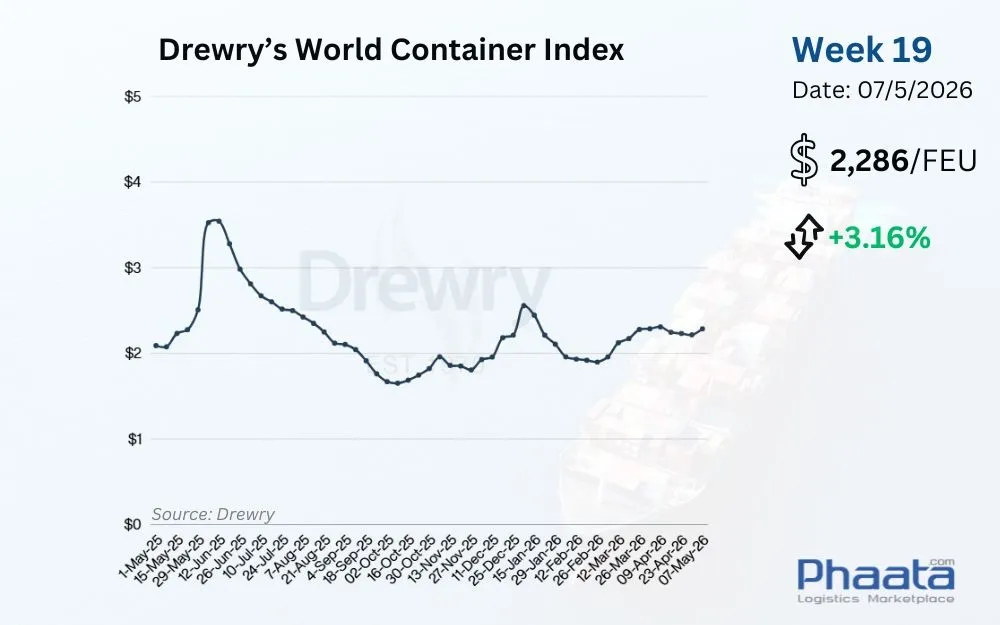
Drewry's World Container Index Week 19/2026 (Photo: Phaata)
2. Asia-North America Ocean Freight Rates
Supply and Demand:
Capacity Squeeze: Vessel capacity will contract sharply over the next few weeks due to a convergence of two factors: a cyclical surge in cargo demand tied to the May holidays, and a slew of announced blank sailings scheduled for Weeks 20 and 21.
Contract (NAC) Space Tightening: Carriers are strictly slashing the number of containers permitted to load under Named Account Contracts (NAC). Actual vessel loading schedules are in constant flux, driving up the rolled cargo ratio at origin ports. The implementation of new transport contracts amidst blank sailings will inflate yard backlogs compared to previous weeks.
Rate Developments:
Ocean Freight rates from Asia to the North America West Coast in Week 19/2026 increased by 1.23% week-on-week, up to $2,872/FEU. This rate is up 12.19% month-on-month, according to Xeneta data.
Spot Rates Inching Up: The spot rate baseline continued moving sideways in early May, though a few carriers tested the waters with minor hikes on their rate sheets. Heading into the second half of May, direct collection rates will undoubtedly tick upward due to current space scarcity.
Emergency Bunker Surcharge (EBS): The EBS continues to be tacked directly onto freight invoices. Carriers will adjust collection levels on a bi-weekly basis, closely tracking actual oil price differentials in the market.
PSS Delay Forecast: Carriers will lock in Peak Season Surcharge (PSS) levels for the second half of May next week. However, based on actual vessel utilization rates, it is highly likely this PSS will be further postponed to June 1. In fact, several carriers have already dispatched notices delaying PSS collection to freight forwarders.
Stay tuned to Phaata International Logistics Marketplace for in-depth and fast market updates.
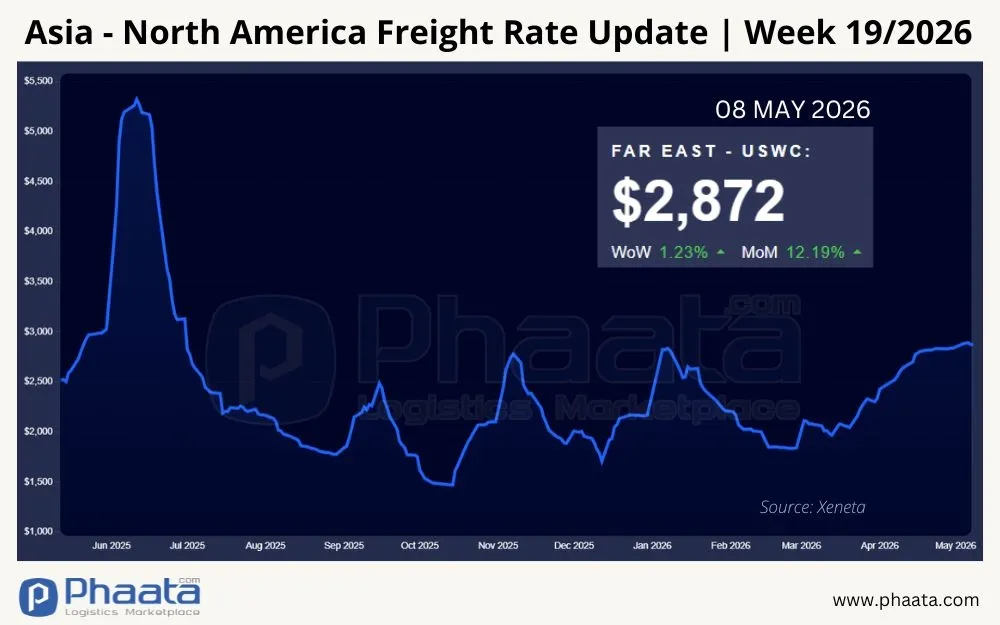
Asia-North America Freight Rates | Week 19/2026 (Photo: Phaata.com)
US Tariff Updates:
1. Warning of Direct Punitive Tariffs on the EU and UK Markets
European (EU) Auto Industry Risk: On May 1, the US President announced a plan to hike import tariffs on cars and trucks originating from the EU from 15% to 25%. This move stems from the gridlock in US-EU trade negotiations (initiated last July) following a May 6 meeting. The US Trade Representative (USTR) has not locked in an official implementation date, nor clarified whether the 25% tariff will apply solely to Completely Built-Up (CBU) vehicles or include parts and components. EU auto parts importers must immediately prepare contingency budgets for a scenario where Landed Costs jump by 10%.
United Kingdom (UK) Goods Risk: The US President threatened to impose a "massive punitive tariff" on UK-origin goods in retaliation against the UK government maintaining a Digital Services Tax (DST) levied on US tech firms (which collected $1.27 billion last year). Although no specific figure has been set, the newly prescribed tariff will exceed this DST revenue, directly threatening the entire portfolio of imports from the UK.
2. Update on IEEPA Refund System (CAPE) Operations and Technical Risks
Customs and Border Protection (CBP) expects to issue the first batch of IEEPA duty refund disbursements on May 11, 2026. However, operational data reveals the documentation department faces massive technical risks:
Application Screening Bottleneck: As of late April, only 21% of total entries were accepted by CAPE for IEEPA duty removal, and a mere 3% had finalized liquidation to enter the ACH refund phase. The entry-specific validation phase rejected 16% (roughly 2.1 million entries) among those that passed the initial screening.
Cash Flow Timeline: Unliquidated entries or those liquidated under 80 days ago will receive funds within 60 to 90 days after CAPE acceptance. Suspended entries, extended entries, or bonded warehouse goods must wait for final liquidation before refunds are issued.
Notes on Post Summary Correction (PSC) and Reconciliation Operations:
-
Audit ACE Data Prior to Submission: Absolutely do not push entries directly to CAPE. The declaration department must run data reconciliation checks within the ACE system to filter out ineligible entries.
-
Handling Entries Rejected by CAPE: Immediately file a PSC to fix the error, then resubmit to the CAPE system.
-
CRITICAL NOTE: Once an entry is successfully accepted by CAPE, PSC usage is banned. Businesses must tightly control Protest deadlines in case CBP overturns the file during the final review process.
-
Closely monitor the group of entries liquidated past 80 days but under 180 days. This group must wait for Phase 2 of CAPE (currently lacking a schedule).
3. New Policy Framework for Metals Tariffs (Section 232)
0% Content Exemption Rule: The Department of Commerce (DOC) applied a Section 232 tariff exemption mechanism (25% or 50%) retroactively from April 6, 2026, for products under Chapters 72, 73, 74, and 76 containing 0% steel, aluminum, or copper. This operation applies directly to products made from cast iron or ductile iron (which are not classified as steel under HTS codes). The customs department needs to audit C/Os and C/Qs to claim refunds on overpaid duties.
Tariff Reduction Process for Canada and Mexico: Steel/aluminum manufacturers from Canada and Mexico are permitted to file for a tariff reduction from 50% to 25% if they meet 3 physical conditions: (1) Smelted/cast entirely in CA/MX meeting USMCA standards; (2) Committed to supplying new factories within the US serving the automotive/medium and heavy-duty vehicle (MHDV) manufacturing sector; (3) The quota enjoying the 25% preference is hard-locked to the exact capacity of the new US factory.
Stay tuned to articles on the Phaata International Logistics Marketplace for rapid and in-depth market updates.
3. Asia-Europe Ocean Freight Rates
Supply and Demand:
Structural Imbalance: The inherent nature of the current Asia-Europe market is defined by two opposing forces: weakened actual purchasing power and a state of overcapacity. Carriers are continuously taking delivery of newbuild container ships, drastically increasing static transport capacity across the trade lane.
Aggressive Blank Sailings: To cope with the overcapacity situation, carriers are proactively withdrawing capacity from the market. According to data from Drewry, the global blank sailing ratio over the next 5 weeks will hit 6%. Notably, up to 42% of these blank sailing orders are aimed directly at the Asia-Europe and Mediterranean routes.
Operations:
Impact of New Tonnage: The Middle East conflict forces the majority of the fleet to maintain the detour around the Cape of Good Hope. Although extending transit times helps absorb a portion of the excess capacity, the massive influx of new vessels entering the market has entirely neutralized this balancing effect.
Signals of Suez Route Restoration: Experimental signs of a return to the Suez Canal have emerged. Specifically, two service loops, Ocean Rise Express (OCR) and EPIC, have routed vessels through Suez on Westbound voyages. This maneuver cuts transit times by 7 to 12 days compared to the African detour.
Defensive Posture: Despite these test runs, the Cape of Good Hope remains the default routing for the entire shipping industry. Shippers and carriers are closely monitoring whether the Suez transits can be maintained stably; the primary barrier lies in the exorbitant costs of War Risk Insurance premiums.
Freight Rate Developments:
Ocean Freight rates from Asia to Europe in Week 19/2026 decreased by 0.28% week-on-week, down to $2,456/FEU. This rate is down 11.59% month-on-month, per Xeneta data.
Spot Rate Slide: The Shanghai Containerized Freight Index (SCFI) for the North Europe route closed at $1,521/TEU (as of April 30). Spot rates continue to face downward pressure as consumption in the European retail market stagnates.
May Surcharge Matrix: Starting May 1, major carriers uniformly applied a raft of new surcharges aimed at directly offsetting the bunker costs incurred by the Cape of Good Hope detour.
Re-establishing the Price Floor: Even as base rates continuously slide due to overcapacity, carriers are successfully defending the price floor. Combining strict blank sailing discipline and rigidly imposing new surcharges serves as the technical barricade preventing rates from going into freefall.
Stay tuned to Phaata International Logistics Marketplace for in-depth and fast market updates.
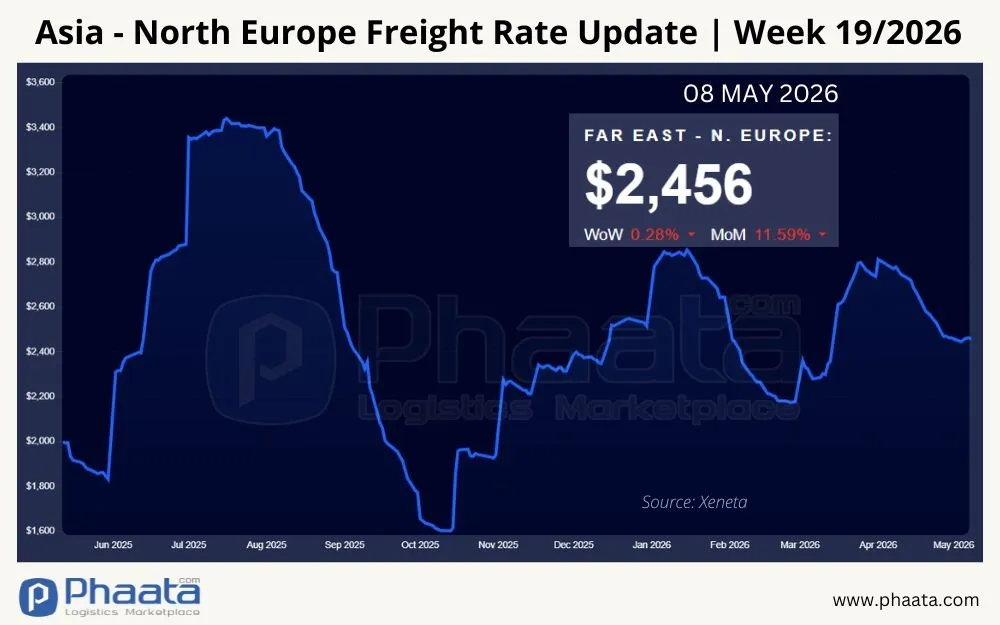
Asia-Europe Freight Rates | Week 19/2026 (Photo: Phaata.com)
4. North America - Asia Ocean Freight Rates
Ocean Freight rates from North America (West Coast) to Asia in Week 19/2026 decreased by 2.79% week-on-week, down to $628/FEU. This rate is up 6.62% month-on-month, according to Xeneta data.
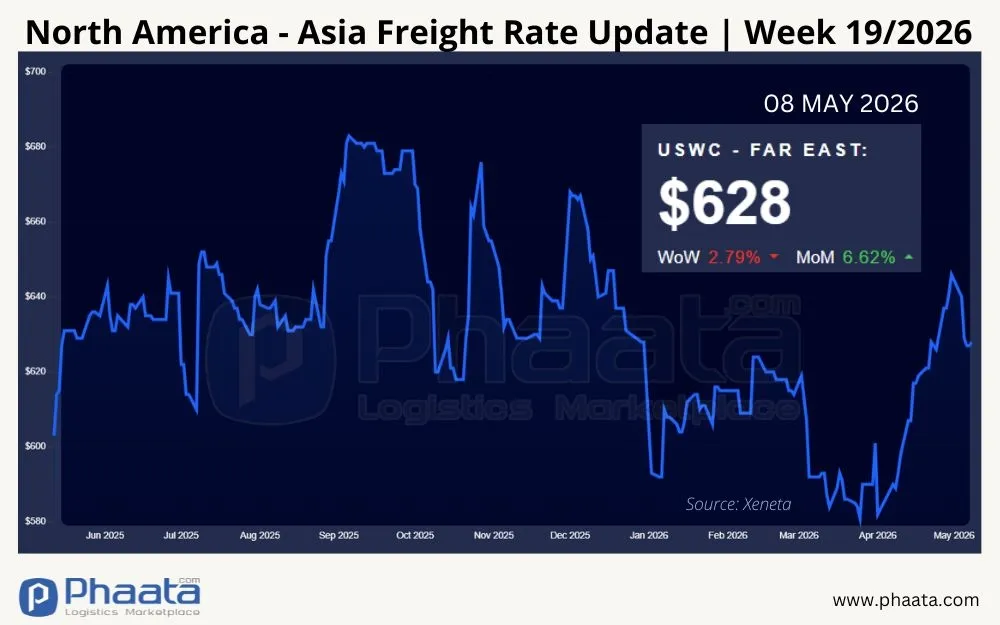
North America (West Coast) - Asia freight rates | Week 19/2026 (Photo: Phaata.com)
5. Northern Europe - Asia Ocean Freight Rates
Ocean Freight rates from North Europe to Asia in Week 19/2026 decreased by 10.28% week-on-week, down to $227/FEU. This rate is up 2.25% month-on-month, per Xeneta data.
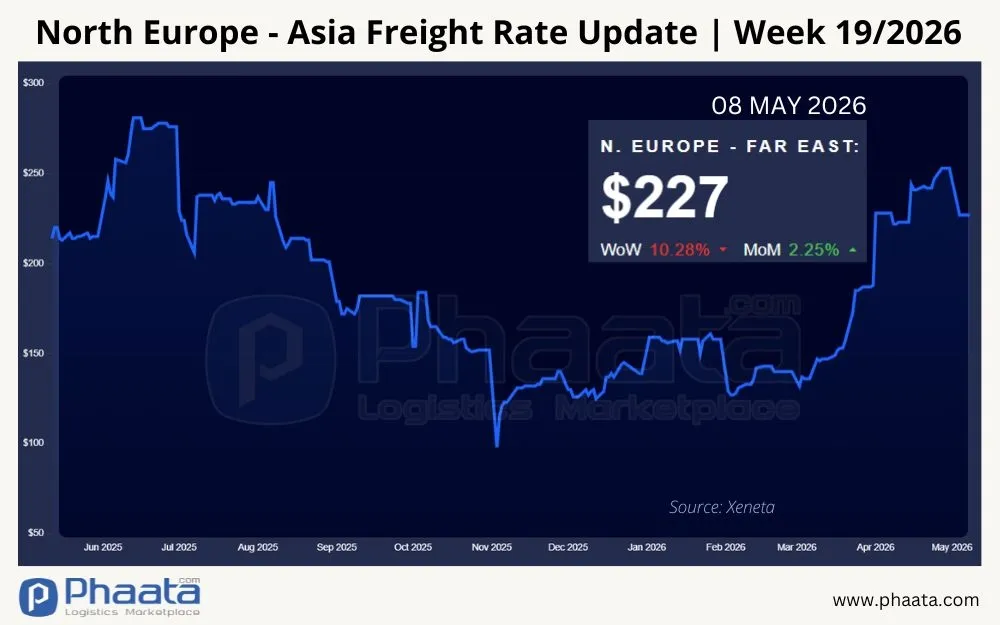
Container Freight rates from Northern Europe to Asia | Week 19/2026 (Photo: Phaata.com)
6. Conclusion and Recommendations from Phaata
The international logistics market over the past week is forming three "hotspots" directly impacting the stability of the global supply chain:
Supply-Demand Polarization Between Arterial Routes: The Asia-North America route is entering a "bottleneck" phase as carriers tighten space on long-term contracts (NAC) to push cargo onto spot rates. Conversely, the Asia-Europe route is buckling under actual overcapacity pressure due to continuous newbuild deliveries, forcing carriers to employ the "extreme measure" of concentrating 42% of global blank sailings on this route to defend the price floor.
Financial Risk from Tariff Policy Shifts: Declarations to hike tariffs on EU cars to 25% and threats of punitive tariffs on UK goods demonstrate that the US is wielding tariffs as a blunt political negotiating tool. This completely alters businesses' short-term Landed Cost calculations.
Technical Bottlenecks in Refund Procedures: The 16% entry rejection rate by the CAPE system is an alarming figure, indicating severe data discrepancies in many businesses' ACE data. The first disbursement on May 11 is a positive signal, but it only applies to the group of clean files (a mere 3-21%).
Recommendations from Phaata
Based on actual market volatility, businesses should note the following:
1. Transport and Bookings:
For the North America Route: Take heed not to wait for NAC vessel schedules if cargo has an urgent delivery deadline. Businesses must prepare budgets for FAK rates (spot prices) to lift excess volumes. Bookings should be locked in at least 14-21 days in advance to avoid the rising cargo roll ratios during Weeks 20-21.
For the Europe Route: Capitalize on the current rate dip to negotiate large shipments. However, closely monitor the war risk insurance situation if opting for experimental voyages through the Suez Canal (like OCR or EPIC) to shave 12 days off transit times.
2. Customs and Taxes:
Audit Metal Portfolios Immediately: The documentation department must isolate items under Chapters 72, 73, 74, and 76 made from cast iron or ductile iron (0% steel/aluminum/copper). This is "suspended cash" that businesses can recover via the retroactive Section 232 exemption mechanism starting April 6, 2026.
Audit Data Before CAPE Submission: Absolutely forbid pushing files to the CAPE system without reconciling against ACE data. If errors are detected, a PSC (Post Summary Correction) must be filed to standardize the data first, because once CAPE accepts the file, the business loses the right to amend information.
3. Cost Management:
Tariff Contingency Budgets: Importers of auto parts from the EU and goods from the UK must create contingency cost spreadsheets factoring in an additional 10% to 20% tariff increase. This helps businesses adjust selling prices or source alternative suppliers promptly before the tariffs officially activate.
4. Procurement Planning:
Accelerate imports of goods from the EU and UK directly in May 2026 to dodge the punitive tariff wave potentially hitting at the end of Q2. For new contracts with Canadian and Mexican partners, require them to provide on-site smelting/casting certifications to enjoy the preferential 25% tariff rate instead of 50% under the new Section 232 rules.
Stay tuned to articles on Phaata.com or Phaata fanpage for rapid and in-depth market updates.
Find Freight Rates Here
Find Logistics Companies Here
See more:
- Hormuz Traffic in Freefall: Iran Tightens Its Grip as the World Waits to See What 'Reopening' Really Means
- Yang Ming Expands Far East - Latin America Service Network Through Agreements with HMM and ONE
- Maersk Q1 2026: Solid Growth Despite Freight Rate Pressures and Geopolitical Instability
- Shipping Lines Adrift in Uncertainty: When Will the Strait of Hormuz Truly Reopen?
- Global Schedule Reliability Hits Year-to-Date High in March 2026
- Two US Destroyers Enter the Persian Gulf, Washington Declares Absolute Control Over the Strait of Hormuz
- COSCO schedules: Vietnam - North America in May 2026
- COSCO updates Vietnam-Intra Asia sailing schedules in May 2026
- COSCO updates Vietnam-North Europe sailing schedules in May 2026
- COSCO updates sailing schedules of Vietnam - South America & Africa in May 2026
- COSCO updates sailing schedules of Vietnam-Middle East & Oceania in May 2026
- SITC updates Vietnam-Intra Asia sailing schedules in May 2026
Source: Phaata - Vietnam's First International Logistics Marketplace
► Find Better Freight Rates & Logistics Service Providers!


Featured News
- Hapag-Lloyd applies Peak Season Surcharge from East Asia to USA and Canada
- The world\'s largest container ships MSC Irina and MSC Loreto floated
- MSC (Mediterranean Shipping Company) - The world\'s leading container shipping lines
- Information you need to know about Maersk Line
- Top 10 export and import goods between Vietnam - Philippines in the first 5 months of 2020

 Market News
See more




_-_Copy.webp)
.webp)

 HOT PROMO
See more
812
 FCL
FCL
 2 Days
 Freight cost

CÔNG TY TNHH PIO LOGISTICS
1720
FCL
31 Days
Freight cost

CÔNG TY TRÁCH NHIỆM HỮU HẠN DT LOGISTICS (VN)
2774
FCL
30 Days
Freight cost

CÔNG TY TNHH PEGASHIP
4358
FCL
45 Days
Freight cost

Compass Logistics
 Premium
5406
FCL
30 Days
Freight cost
Premium
5406
FCL
30 Days
Freight cost

CÔNG TY TNHH INTERNATIONAL LOGISTICS GLORY (VIỆT NAM)
Why do thousands of businesses trust Phaata?
USERS/MONTH
LOGISTICS COMPANIES
REQUEST FOR QUOTEŚ
QUOTATIONS
VIETNAM LOGISTICS COMMUNITY
5 Steps to Get the Best Quote
Find a price quickly/Send a RFQ
Compare multiple options
Contact for Further Consultation
Negotiating prices/services
Management & rating
 Freight rates
Sea freight
- FCL
See more
13
40
Days Direct
- ₫196,223,145 / 20'GP
- ₫229,301,895 / 40'GP
- ₫229,301,895 / 40'HQ

ALLIANCE INTERNATIONAL LOGISTICS CO., LTD
Premium
231
 247
22
Days Direct
247
22
Days Direct
- ₫179,948,400 / 40'RQ

CÔNG TY CỔ PHẦN QUỐC TẾ ANVY
241
13
Days Direct
- ₫75,419,550 / 40'RQ

CÔNG TY TNHH VẬN CHUYỂN QUỐC TẾ RYLOGS
209
35
Days Direct
- ₫195,826,200 / 20'GP
- ₫243,459,600 / 40'GP
- ₫243,459,600 / 40'HQ

CÔNG TY TNHH TIẾP VẬN TOÀN CẦU KM
Sea freight
- LCL
See more
630
7
Days Direct
- ₫105,852 /cbm

Công ty Cổ phần vận tải xuyên đại dương OVC
3,216
4
Days Direct
- ₫26,463 /cbm

CÔNG TY TNHH IEC EXPRESS (VIỆT NAM)- CHI NHÁNH HÀ NỘI
4,280
5
Days Direct
- ₫26,463 /cbm

CHI NHÁNH TẠI THÀNH PHỐ HỒ CHÍ MINH - CÔNG TY CỔ PHẦN MG LOGISTICS
4,696
8
Days Direct
- Refund ₫2,362,500 /cbm

CÔNG TY CỔ PHẦN TIẾP VẬN INTERCARGO
4,914
4
Days Direct
- ₫26,463 /cbm

CÔNG TY CỔ PHẦN GIAO NHẬN VẬN TẢI MỸ Á (ASL LOGISTICS)
 Air freight
- General cargo
Air freight
- General cargo
See more
1,759
10
Days Transit
- 264,630 ₫/kg

Phoenix Logistics Vietnam - chi nhánh TP. Hồ Chí Minh (Phoenix International Forwarding Vietnam )
2,854
1
Days Direct
- 185,241 ₫/kg

CÔNG TY TNHH THƯƠNG MẠI VÀ DỊCH VỤ FASTRANS
6,193
 5,761
8
Days Transit
5,761
8
Days Transit
- 224,936 ₫/kg

CÔNG TY TNHH SEA GLOBAL VIỆT NAM
3,154
1
Days Direct
- 502,797 ₫/kg

CÔNG TY TNHH VẬN TẢI QUỐC TẾ GIA PHÚ
 Rail freight
- FCL
Rail freight
- FCL
See more
40
5
Days Direct
- ₫44,987,100 / 40'HQ
- ₫44,987,100 / 45'HQ

CÔNG TY TNHH PHƯỚC TÁ
323
3
Days Direct
- ₫15,083,910 / 40'HQ

CÔNG TY CỔ PHẦN VẬN TẢI VÀ THƯƠNG MẠI ĐƯỜNG SẮT
11,283
7
Days Direct
- ₫48,956,550 / 20'GP

Công ty TNHH T&M Forwarding
10,512
5
Days Direct
- ₫7,145,010 / 20'GP

ASIAN EXPRESS LINE VIETNAM ( AEL VIET NAM )
8,524
10
Days Direct
- ₫9,262,050 / 20'GP

CÔNG TY CỔ PHẦN LOGISTICS QUỐC TẾ V&T
 Road freight
- FCL
Road freight
- FCL
See more
41
1
Day
- ₫28,000,000 / 20'GP
- ₫28,000,000 / 40'GP

CÔNG TY TNHH THƯƠNG MẠI DỊCH VỤ VÀ KHO VẬN VIETTEL POST - TTC
65
4
Day
- ₫211,704 / 20'GP

CÔNG TY CỔ PHẦN KINH DOANH THƯƠNG MẠI VÀ DỊCH VỤ HỎA TỐC
43,346
1
Day
- ₫6,868,686 / 20'OT
- ₫6,868,686 / 40'OT
- ₫6,868,686 / 40'OT HQ

CÔNG TY TNHH LIÊN VẬN QUỐC TẾ SHINING OCEAN VIỆT NAM
101,100
2
Day
- ₫6,500,000 / 40'RF
- ₫6,500,000 / 40'RQ
- ₫6,500,000 / 45'RQ

CÔNG TY CP PROSHIP
Premium
171,148
1
Day
- ₫18,997,200 / 20'GP
- ₫18,997,200 / 40'GP

CÔNG TY CỔ PHẦN GIAO NHẬN VẬN TẢI CON ONG


