


Monday, 20/04/2026, 11:00 (GMT +7)
 924
924
International Shipping and Logistics Market Update Week 16/2026 | Phaata
International shipping and logistics market update - Week 16/2026
Table of Contents
-
World Container Index Week 16/2026
-
Asia - North America Ocean Freight Rates
-
Asia - Europe Ocean Freight Rates
-
Northern America - Asia Ocean Freight Rates
-
Northern Europe - Asia Ocean Freight Rates
-
Conclusions and Recommendations by Phaata
1. World Container Index Week 16/2026
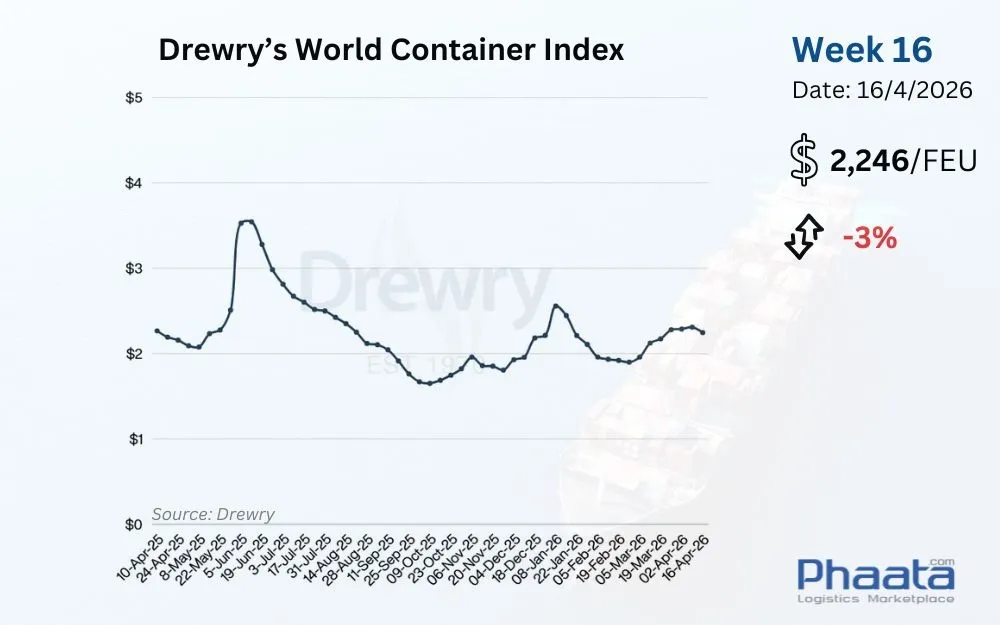
Drewry’s World Container Index (WCI) for Week 16/2026 (from April 13 to April 19, 2026) decreased by 3% compared to the previous week, settling at $2,246/FEU.
Drewry's World Container Index Week 16/2026 (Photo: Phaata)
2. Asia-North America Ocean Freight Rates
Supply and Demand:
Demand Side:
Total import cargo volumes into the North American market have continued to record actual growth momentum in recent weeks.
Supply Side:
Carriers are proactively stepping up the frequency of blank sailings, with plans extending through mid-May. The focus of this capacity withdrawal is directly aimed at services discharging on the US East Coast (USEC) and the Pacific Northwest (PNW).
Operations:
The combination of growing export volumes and the tightening of space via blank sailings has significantly improved vessel utilization rates on active sailings.
Rate Developments:
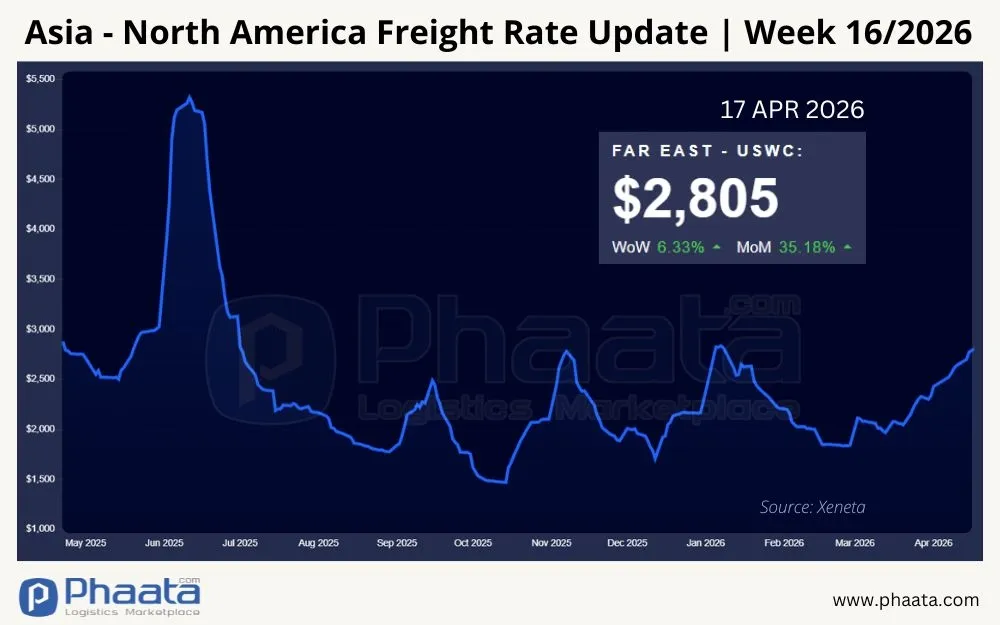
Ocean Freight rates from Asia to the North America West Coast in Week 16/2026 increased by 6.33% week-on-week, reaching $2,805/FEU. This rate is up 35.18% month-on-month, according to Xeneta data.
Status of carrier surcharge applications:
- GRI Momentum Broken: Carriers' efforts to implement the April 15 General Rate Increase (GRI) failed as the new rate levels quickly collapsed in the actual trading market. To cope, carriers were forced to pivot to extending the current freight rates through the end of April.
- Bunker Surcharges (EBS & IFS): The Emergency Bunker Surcharge (EBS) for the ocean leg continues to be maintained. Notably, to offset rising diesel costs in intermodal transport (inland rail/truck), carriers will activate supplementary Intermodal Fuel Surcharges (IFS) in two phases: April 17 and May 1.
- Peak Season Surcharge (PSS) Delayed: The simultaneous application of fuel surcharges (EBS and IFS) pushed total transport costs in April to exceptionally high levels. To avoid pressure from shippers, carriers were forced to push back the PSS collection schedule to May 1.
Stay tuned to Phaata International Logistics Marketplace for in-depth and fast market updates.
Asia-North America Freight Rates | Week 16/2026 (Photo: Phaata.com)
US Tariff Updates:
1. Launch of IEEPA Refund System (CAPE) Phase 1 and Operational Bottlenecks US Customs and Border Protection (CBP) confirmed it will officially launch Phase 1 of the CAPE system on April 20, 2026. However, the actual deployment process is revealing numerous operational risks:
- Limited Processing Scope: Phase 1 will only process approximately 63% of total eligible entries. Specifically, the system will only accept unliquidated entries or liquidated entries still within the most recent 80-day window. Finally liquidated entries and the remaining 37% of entries (including Duty Drawback, Reconciliation, and those with an open Protest) will be suspended, pending processing in later phases without a specific timeline.
- PSC Usage Banned: CBP strictly prohibits importers from utilizing the Post Summary Correction (PSC) tool to self-initiate IEEPA refunds. All unliquidated entries must be processed centrally through the CAPE portal.
- Technical Bottleneck for AD/CVD Goods: CBP is deadlocked in processing pre-liquidation refunds for entries suspended due to Anti-Dumping/Countervailing Duty (AD/CVD) orders. Manually processing this group risks crashing the customs agency's operational system.
- Disbursement and System Risks: Despite committing to a 45-day processing timeframe, CBP has yet to issue an official disbursement procedure. The massive volume of 53 million entries from over 330,000 importers puts the ACE system at risk of severe congestion. Unclear validation processes mean the risk of application rejection due to data discrepancies is very high.
2. Geopolitical Tariff Risk: Threat of 50% Tariff on Chinese Goods
- Context: On April 12, citing intelligence reports regarding China supplying air defense systems to Iran, President Trump directly named China as the target of a 50% punitive tariff.
- Risk Assessment: Although the specific legal tool (possibly Section 338 or Section 232) has not been announced, this declaration creates a massive risk of supply chain disruption. Businesses relying on sourcing from China must immediately activate contingency plans and re-evaluate their Landed Cost should the 50% tariff scenario be implemented unannounced.
3. Crucial Update on Section 232 Tariffs
- For Metals (Steel, Aluminum, Copper): The new tariff rates (flat 50% or 25% for derivatives) officially took effect on April 6, 2026. Core note: Businesses must calculate the tariff on the total commercial invoice value of the finished product, and are not permitted to carve out the metal proportion.
- For Pharmaceuticals: The 100% tariff on patented drugs non-compliant with MFN pricing will take effect on July 31, 2026 (for major corporations). Tariff reduction incentives only apply to businesses with plans to reshore production to the US or for goods originating from specified markets (Japan, EU, South Korea, UK, Switzerland).
Stay tuned to articles on the Phaata International Logistics Marketplace for rapid and in-depth market updates.
3. Asia-Europe Ocean Freight Rates
Supply and Demand:
Demand:
Import demand in the European market continues to be bleak due to general economic stagnation in the Eurozone. The energy price shock combined with risks from the Middle East conflict is driving inflation to a 3-year high, directly strangling consumer purchasing power.
Supply:
The maritime route via the Suez Canal remains blockaded and is unlikely to be restored before mid-2026. The transport route around the Cape of Good Hope (Africa) has officially become the default, automatically absorbing between 15% and 20% of total fleet utilization across the trade lane.
To protect freight rates, carriers are maintaining a high blank sailing ratio of 6.5% during the period from April 6 to May 10. This maneuver directly neutralizes approximately 15-16% of actual operational capacity in the market.
Operations:
The operational network is under immense pressure from extreme weather and cargo backlogs at all 3 critical links:
- At Port of Loading (Qingdao - China): Strong wind gusts and vessel bunching are causing berthing wait times to stretch severely from 72 to 96 hours.
- At Transshipment Hub (Singapore): Yard utilization remains anchored at a high 80%. Importers need to proactively add 7 to 14 days to their estimated delivery times as transshipment cycles are prolonged.
- At Destination Ports (North Europe): Harsh weather in Antwerp, Hamburg, and Rotterdam is reducing berth productivity and stalling domestic barge turnarounds along the Rhine River. Consequently, inland transport connection dwell times are being pushed up to 3 to 5 days.
Freight Rate Developments:
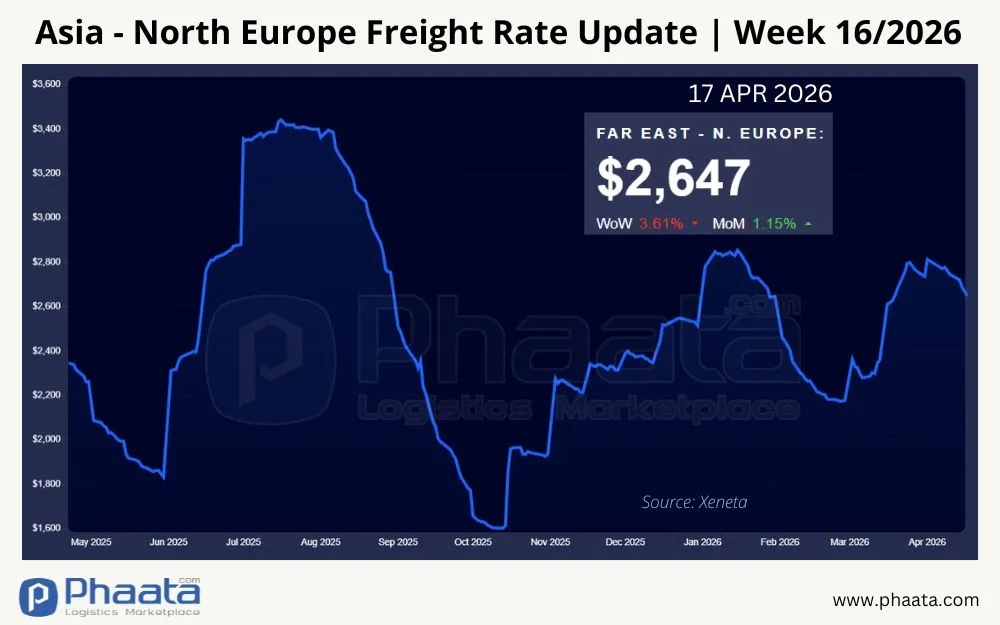
Ocean Freight rates from Asia to Europe in Week 16/2026 decreased by 3.61% week-on-week, down to $2,647/FEU. This rate increased slightly by 1.15% month-on-month, according to Xeneta data.
Spot Rate Slide: The Shanghai Containerized Freight Index (SCFI) peaked at $1,703 in Week 14 but immediately recorded a prolonged downward slide extending into Week 17 due to extremely weak actual order volumes.
Holding the Baseline: Despite the declining SCFI, actual market freight rates have maintained a stable sideways trend. Carriers are defending the price floor very successfully thanks to strict supply-tightening discipline through continuous blank sailing programs.
Stay tuned to Phaata International Logistics Marketplace for in-depth and fast market updates.
Asia-Europe Freight Rates | Week 16/2026 (Photo: Phaata.com)
4. North America - Asia Ocean Freight Rates
Ocean Freight rates from North America (West Coast) to Asia in Week 16/2026 continued to increase by 3.51% week-on-week, up to $619/FEU. This rate is up 4.38% month-on-month, according to Xeneta data.
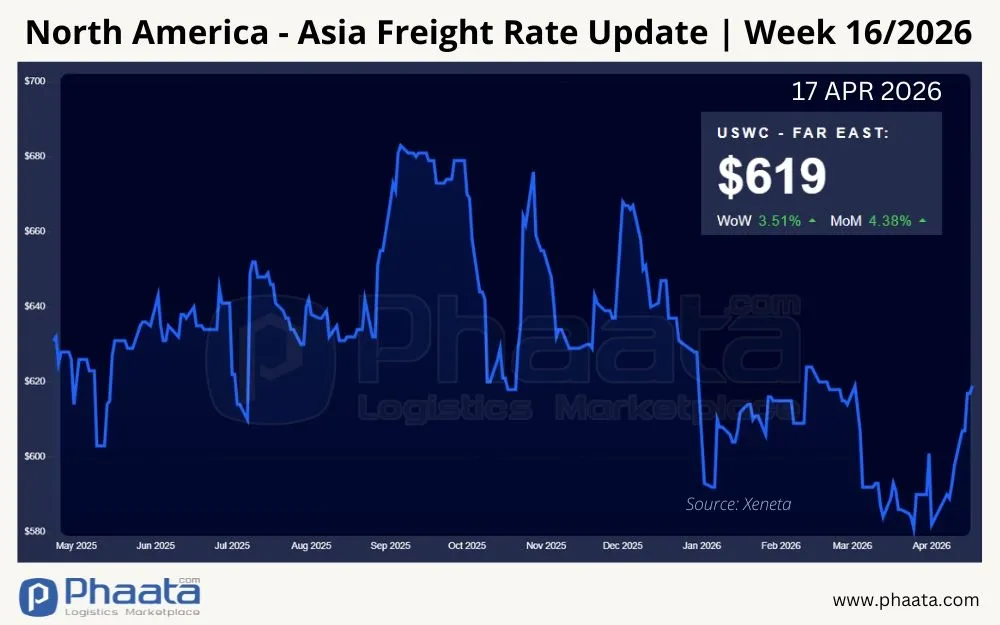
North America (West Coast) - Asia freight rates | Week 16/2026 (Photo: Phaata.com)
5. Northern Europe - Asia Ocean Freight Rates
Ocean Freight rates from North Europe to Asia in Week 16/2026 increased by 8.07% week-on-week, up to $241/FEU. This rate is up 58.55% month-on-month, per Xeneta data.
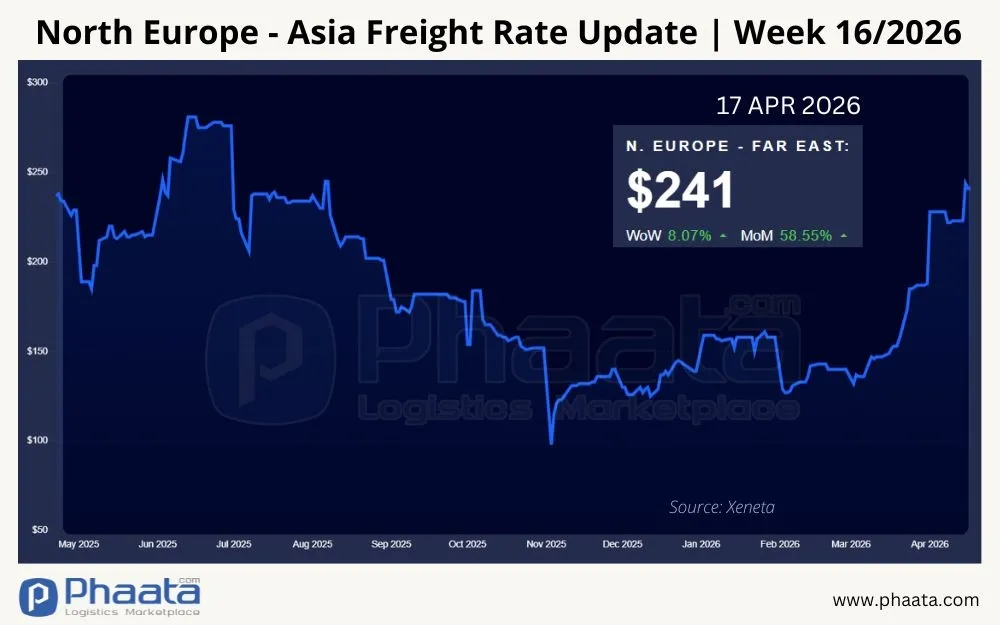
Container Freight rates from Northern Europe to Asia | Week 16/2026 (Photo: Phaata.com)
6. Conclusion and Recommendations from Phaata
Operational and policy data for Week 16/2026 establish three critical risks directly impacting global supply chain costs and schedules:
- Rate Divergence Under Artificial Pressure: The Asia-North America (TPEB) route maintained strong upward momentum (up 6.33%) thanks to carriers tightening capacity and imposing a matrix of fuel surcharges (EBS, IFS), despite the failure of the April 15 GRI. Conversely, the Asia-Europe (FEWB) route continued its price slide (down 3.61%) due to weak purchasing power, though the price floor was successfully defended by neutralizing 15-16% of actual capacity via blank sailings.
- Physical Supply Chain Congestion: The transport network is bottlenecked at 3 hotspots: Qingdao (4-day berthing wait due to weather), Singapore (80% yard density, transshipment backlog), and North Europe (prolonged barge dwell times). The container turnaround cycle continues to rupture.
- Financial and Legal Risks in the US: The CAPE Phase 1 system (IEEPA refunds) launching April 20 revealed severe technical limitations by excluding 37% of entries. Simultaneously, the threat of a 50% tariff on Chinese goods and the new Section 232 calculation method (on 100% of finished product value) directly erode importer profit margins.
Recommendations from Phaata
To protect cash flow and maintain cargo streams, businesses must note the following:
1. Logistics and Order Management:
- North America Route (TPEB) - Lock Exports Before May 1: Carriers will activate the Peak Season Surcharge (PSS) and the second round of Intermodal Fuel Surcharges (IFS) on May 1. The documentation department must lock bookings and push cargo onto vessels in the second half of April. It is mandatory to demand agents separate the IFS from the ocean freight to control auditing costs for the US inland transport leg.
- Europe Route (FEWB) - Adjust Lead Time: Do not expect spot rates to drop much further as the blank sailing ratio is anchored at 6.5%. Shippers need to directly add 10 to 14 days to the Estimated Time of Delivery (ETD/ETA) on foreign trade contracts to offset the risk of ships anchoring for berths in Qingdao and missing transshipment connections in Singapore.
2. Customs and Risk Management (US Market):
- Processing IEEPA Refund Files (CAPE System): Absolutely do not use the Post Summary Correction (PSC) tool to claim refunds. For the 37% of entries excluded from CAPE Phase 1 (Drawback, AD/CVD, finalized entries), direct your customs broker to continue filing manual Protests to lock in legal rights. Urgently review the ACE portal to ensure the Automated Clearing House (ACH) account is active.
- Activate Contingency Plans for Chinese Sourcing: Facing the sudden 50% tariff threat from the White House, the Procurement department must immediately audit the portfolio of goods imported from China. Re-evaluate Landed Costs and prepare a plan to shift orders to backup suppliers in the Southeast Asian region.
- Section 232 Tariff Audit: The Accounting department must immediately apply the Section 232 formula calculated on the total commercial invoice value for metals and derivatives arriving at ports from April 6. Recalculate the Cost of Goods Sold (COGS) instantly to avoid selling at a loss due to the tax structure differential.
Stay tuned to articles on Phaata.com or Phaata fanpage for rapid and in-depth market updates.
Find Freight Rates Here
Find Logistics Companies Here
See more:
- WorldACD: Air Freight Rates Skyrocket Despite Global Volume Decline
- Logistics Layoffs Surpass 800 Mark Amid Warehousing and Transport Contract Volatility
- Uncertainty at the Strait of Hormuz: Fleets of Commercial Vessels Make Sudden U-Turns
- Strait of Hormuz Officially Reopens: Hope for Over 900 Stranded Vessels
- Iran's Floating Storage Oil Export Strategy and Washington's Response
- Air Freight Supply Chain Disruptions Send Gulf Food Prices Soaring
- 2025 Global Air Logistics Landscape: The Top 10 Busiest Cargo Airports
- COSCO updates Vietnam-Intra Asia sailing schedules in Apr 2026
- COSCO schedules: Vietnam - North America in Apr 2026
- SITC updates Vietnam-Intra Asia sailing schedules in Apr 2026
Source: Phaata - Vietnam's First International Logistics Marketplace
► Find Better Freight Rates & Logistics Service Providers!


Featured News
- Hapag-Lloyd applies Peak Season Surcharge from East Asia to USA and Canada
- The world\'s largest container ships MSC Irina and MSC Loreto floated
- MSC (Mediterranean Shipping Company) - The world\'s leading container shipping lines
- Information you need to know about Maersk Line
- Top 10 export and import goods between Vietnam - Philippines in the first 5 months of 2020

 Market News
See more


_-_Copy.webp)
.webp)

 HOT PROMO
See more
815
 FCL
FCL
 2 Days
 Freight cost

CÔNG TY TNHH PIO LOGISTICS
1723
FCL
31 Days
Freight cost

CÔNG TY TRÁCH NHIỆM HỮU HẠN DT LOGISTICS (VN)
2779
FCL
30 Days
Freight cost

CÔNG TY TNHH PEGASHIP
4362
FCL
45 Days
Freight cost

Compass Logistics
 Premium
5408
FCL
30 Days
Freight cost
Premium
5408
FCL
30 Days
Freight cost

CÔNG TY TNHH INTERNATIONAL LOGISTICS GLORY (VIỆT NAM)
Why do thousands of businesses trust Phaata?
USERS/MONTH
LOGISTICS COMPANIES
REQUEST FOR QUOTEŚ
QUOTATIONS
VIETNAM LOGISTICS COMMUNITY
5 Steps to Get the Best Quote
Find a price quickly/Send a RFQ
Compare multiple options
Contact for Further Consultation
Negotiating prices/services
Management & rating
 Freight rates
Sea freight
- FCL
See more
14
40
Days Direct
- ₫196,223,145 / 20'GP
- ₫229,301,895 / 40'GP
- ₫229,301,895 / 40'HQ

ALLIANCE INTERNATIONAL LOGISTICS CO., LTD
Premium
235
 253
22
Days Direct
253
22
Days Direct
- ₫179,948,400 / 40'RQ

CÔNG TY CỔ PHẦN QUỐC TẾ ANVY
246
13
Days Direct
- ₫75,419,550 / 40'RQ

CÔNG TY TNHH VẬN CHUYỂN QUỐC TẾ RYLOGS
210
35
Days Direct
- ₫195,826,200 / 20'GP
- ₫243,459,600 / 40'GP
- ₫243,459,600 / 40'HQ

CÔNG TY TNHH TIẾP VẬN TOÀN CẦU KM
Sea freight
- LCL
See more
635
7
Days Direct
- ₫105,852 /cbm

Công ty Cổ phần vận tải xuyên đại dương OVC
3,224
4
Days Direct
- ₫26,463 /cbm

CÔNG TY TNHH IEC EXPRESS (VIỆT NAM)- CHI NHÁNH HÀ NỘI
4,286
5
Days Direct
- ₫26,463 /cbm

CHI NHÁNH TẠI THÀNH PHỐ HỒ CHÍ MINH - CÔNG TY CỔ PHẦN MG LOGISTICS
4,702
8
Days Direct
- Refund ₫2,362,500 /cbm

CÔNG TY CỔ PHẦN TIẾP VẬN INTERCARGO
4,915
4
Days Direct
- ₫26,463 /cbm

CÔNG TY CỔ PHẦN GIAO NHẬN VẬN TẢI MỸ Á (ASL LOGISTICS)
 Air freight
- General cargo
Air freight
- General cargo
See more
1,762
10
Days Transit
- 264,630 ₫/kg

Phoenix Logistics Vietnam - chi nhánh TP. Hồ Chí Minh (Phoenix International Forwarding Vietnam )
2,861
1
Days Direct
- 185,241 ₫/kg

CÔNG TY TNHH THƯƠNG MẠI VÀ DỊCH VỤ FASTRANS
6,199
 5,767
8
Days Transit
5,767
8
Days Transit
- 224,936 ₫/kg

CÔNG TY TNHH SEA GLOBAL VIỆT NAM
3,157
1
Days Direct
- 502,797 ₫/kg

CÔNG TY TNHH VẬN TẢI QUỐC TẾ GIA PHÚ
 Rail freight
- FCL
Rail freight
- FCL
See more
42
5
Days Direct
- ₫44,987,100 / 40'HQ
- ₫44,987,100 / 45'HQ

CÔNG TY TNHH PHƯỚC TÁ
334
3
Days Direct
- ₫15,083,910 / 40'HQ

CÔNG TY CỔ PHẦN VẬN TẢI VÀ THƯƠNG MẠI ĐƯỜNG SẮT
11,295
7
Days Direct
- ₫48,956,550 / 20'GP

Công ty TNHH T&M Forwarding
10,520
5
Days Direct
- ₫7,145,010 / 20'GP

ASIAN EXPRESS LINE VIETNAM ( AEL VIET NAM )
8,528
10
Days Direct
- ₫9,262,050 / 20'GP

CÔNG TY CỔ PHẦN LOGISTICS QUỐC TẾ V&T
 Road freight
- FCL
Road freight
- FCL
See more
43
1
Day
- ₫28,000,000 / 20'GP
- ₫28,000,000 / 40'GP

CÔNG TY TNHH THƯƠNG MẠI DỊCH VỤ VÀ KHO VẬN VIETTEL POST - TTC
74
4
Day
- ₫211,704 / 20'GP

CÔNG TY CỔ PHẦN KINH DOANH THƯƠNG MẠI VÀ DỊCH VỤ HỎA TỐC
43,355
1
Day
- ₫6,868,686 / 20'OT
- ₫6,868,686 / 40'OT
- ₫6,868,686 / 40'OT HQ

CÔNG TY TNHH LIÊN VẬN QUỐC TẾ SHINING OCEAN VIỆT NAM
101,106
2
Day
- ₫6,500,000 / 40'RF
- ₫6,500,000 / 40'RQ
- ₫6,500,000 / 45'RQ

CÔNG TY CP PROSHIP
Premium
171,149
1
Day
- ₫18,997,200 / 20'GP
- ₫18,997,200 / 40'GP

CÔNG TY CỔ PHẦN GIAO NHẬN VẬN TẢI CON ONG


