


Tuesday, 31/03/2026, 10:37 (GMT +7)
 2162
2162
International Shipping and Logistics Market Update Week 13/2026 | Phaata

International shipping and logistics market update - Week 13/2026
Table of Contents
-
World Container Index Week 13/2026
-
Asia - North America Ocean Freight Rates
-
Asia - Europe Ocean Freight Rates
-
Northern America - Asia Ocean Freight Rates
-
Northern Europe - Asia Ocean Freight Rates
-
Conclusions and Recommendations by Phaata
1. World Container Index Week 13/2026
Drewry’s World Container Index (WCI) for Week 13/2026 (from Mar 23 to Mar 29, 2026) continued to increase, but at a slower pace, rising by 5% compared to the previous week to $2,279/FEU. This marks the fourth consecutive week of gains following a preceding seven-week period of continuous decline.
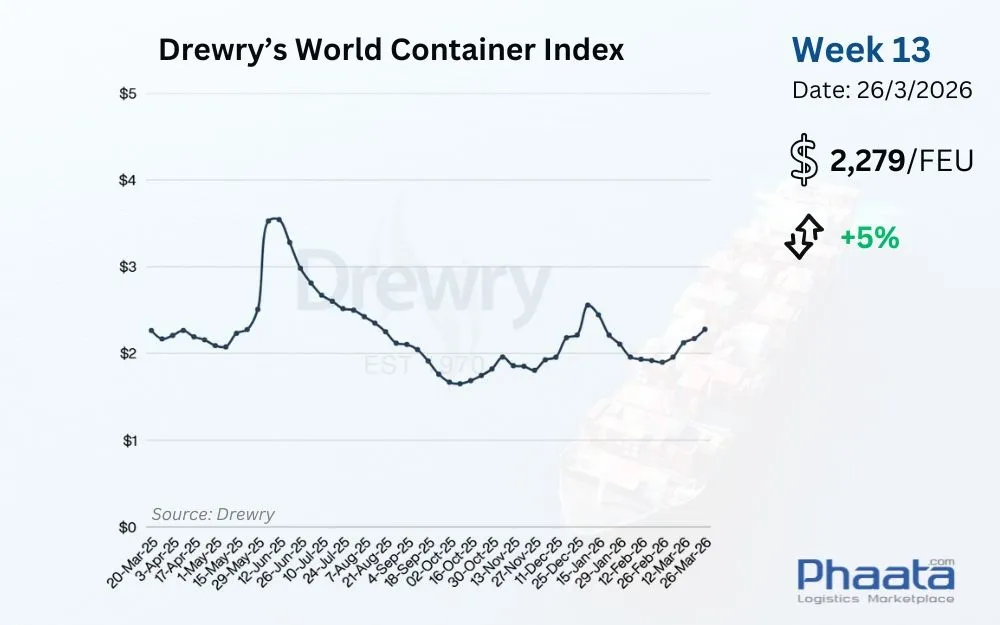
Drewry's World Container Index Week 13/2026 (Photo: Phaata)
2. Asia-North America Ocean Freight Rates
Supply and Demand:
Demand Side:
Booking volumes are showing signs of a mild recovery; however, total export cargo output remains low. This discrepancy continues to deepen the supply-demand imbalance across the trade lane.
Supply Side:
To intervene in the current oversupply situation, carriers have issued official notices regarding an increase in blank sailing ratios for the upcoming month of April. This plan will directly cut between 6% and 10% of total scheduled vessel departures.
Operations:
Equipment Chain Disruption due to Middle East Factors: Although the Trans-Pacific Eastbound (TPEB) route does not directly pass through the war zone, the operational network is still suffering severe indirect impacts. The fact that fleets on other routes are forced to maintain the Cape of Good Hope routing is extending vessel turnarounds. The direct consequence is a localized shortage of empty containers for stuffing exports and congestion at key transshipment hubs in the Asian region.
Rate Developments:
Ocean Freight rates from Asia to the North America West Coast in Week 13/2026 surged by 13.89% week-on-week to $2,329/FEU. This rate is up 26.51% month-on-month, according to Xeneta data.
Carriers are employing revenue maximization tactics by rolling out a series of new surcharges, despite no sudden spike in cargo volumes:
General Rate Increase (GRI): Carriers have enforced GRI collections for the remainder of March. Simultaneously, they continue to issue notices applying an additional round of GRIs, officially effective April 1.
Dual Fuel Surcharges (EFS & IFS): Facing the sudden surge in bunker prices, carriers immediately activated two surcharge mechanisms:
-
Emergency Fuel Surcharge (EFS): Applied to offset marine fuel (bunker) costs for the ocean freight leg.
-
Intermodal Fuel Surcharge (IFS): Applied additionally to cover the differential caused by high diesel prices for intermodal movements by rail and truck inland within the US.
Peak Season Surcharge (PSS) Delayed: Because the cost baseline in April has already been inflated too high by the simultaneous appearance of EFS and IFS, carriers have been forced to push back the PSS application timeline to late April.
Stay tuned to Phaata International Logistics Marketplace for in-depth and fast market updates.
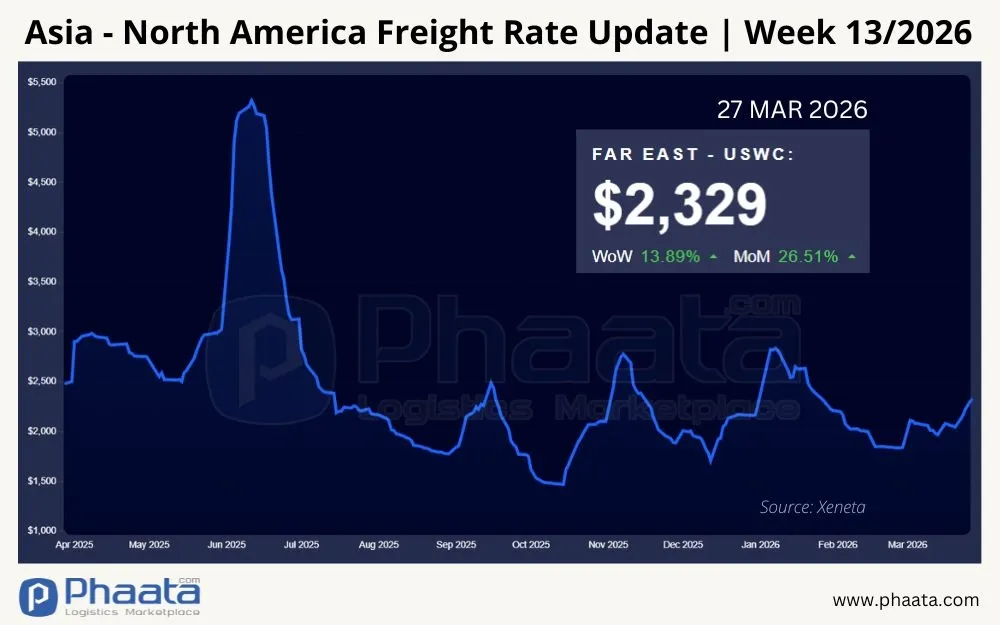
Asia-North America Freight Rates | Week 13/2026 (Photo: Phaata.com)
US Tariff Updates:
1. Expansion of Scope and Update on the IEEPA Automated Refund System (CAPE)
Court Expands Refund Targets: On March 20, the Court of International Trade (CIT) officially expanded the scope of the IEEPA refund order. Alongside reciprocal and "fentanyl" tariffs applied to China, Canada, and Mexico (outlined in the March 4 ruling), the CIT added all IEEPA tariffs the US administration imposed on Brazilian and Indian goods last August to the mandatory refund list.
Sluggish CAPE System Progress: According to a report submitted to the CIT on March 19, the construction progress of US Customs and Border Protection's (CBP) Centralized Account Processing and Management Environment (CAPE) inched up negligibly compared to last week: Filing Portal reached 73% (up 3%); Mass Recalculation reached 45% (up 5%); Disbursement Processing reached 63% (up 3%); while the Liquidation phase remained stagnant at 80%.
Operational Risk: Even though CBP maintains its commitment to launch the system on April 20 (45 days from March 6), this delay is a red flag. Importers absolutely must not wait but must immediately file Protests against IEEPA entries to lock the entry status, preserving refund rights before the 180-day automatic finalization deadline.
2. Risk of Global Tariff (Section 122) Rising to Ceiling Limit
Warning from the White House: On March 25, Senior Trade Advisor Peter Navarro reaffirmed plans to increase the global tariff (Section 122) from the current 10% to its legal ceiling of 15%.
Impact: Although the implementation date is not yet locked in, continuous signaling from senior officials indicates the risk of a 15% tariff hike is extremely imminent. Businesses need to prepare for a scenario where profit margins are eroded by 5% on the total value of goods imported into the US in Q2/2026.
3. Opening of Supplementary Intake Portal for Section 232 Taxable Goods (Auto Parts)
New Process: Starting April 1, 2026, the US Department of Commerce will open a two-week window (until April 14) to accept requests to add new product HS codes to the Section 232 tariff list for the auto parts industry. After April 14, the Commerce Department will conduct a public comment period.
Timeline Precedent: Based on the previous process for adding derivative products in the steel and aluminum industries, it is expected to take approximately 3.5 months from the receipt of requests until the new tariffs officially take effect.
4. Long-Term Tariff Matrix Poised to Replace Section 122 The US administration is urgently preparing long-term legal tools to fill the void when the 10% global tariff (Section 122) mandatorily expires on July 24, 2026:
Dual Section 301 Investigations: USTR is running two parallel investigations: (1) "Overcapacity" investigation into 16 countries (March 11) and (2) "Forced labor" investigation into 60 trading partners (March 12). Key markets like China, the EU, and Vietnam are all in the "dual crosshairs" of both these investigations. Despite the customary 6-18 months, the timeline for conclusions will certainly be compressed to meet the July deadline.
Section 232 (National Security): In addition to 9 open investigations, President Trump has announced the initiation of new Section 232 investigations.
The Ultimate Weapon - Section 338: On March 18, USTR Jamieson Greer revealed the possibility of activating Section 338. This act grants the President blanket authority to impose punitive tariffs of up to 50% against any country accused of discriminating against US commerce, without navigating lengthy investigation processes like Section 301.
Stay tuned to articles on the Phaata International Logistics Marketplace for rapid and in-depth market updates.
3. Asia-Europe Ocean Freight Rates
Supply and Demand:
Demand:
Import cargo demand in the European market is moving sideways, with no sudden surge in volume.
Supply:
Vessel space is depleting. The blockade of the Strait of Hormuz forces 100% of commercial vessels to detour around the Cape of Good Hope. This extended shipping route has absorbed all excess capacity in the market, pushing vessel utilization past the 90% mark in late March.
Operations:
Port infrastructure systems are becoming overloaded due to severe vessel bunching as mega-ships arrive off-schedule due to rerouting. This situation is causing severe landside delays.
At Asian Transshipment Hubs (Singapore): The Port of Singapore is receiving massive volumes of diverted transshipment cargo. Yard utilization remains at an alarming 90%. Vessel berthing wait times are temporarily hovering at 1.5 days as the port struggles to clear backlogs.
At North European Destination Ports: Yard container density has hit the ceiling:
-
Rotterdam: APMT MVII has reached 95%; RWG is at 85%.
-
Hamburg: CTH has reached 90%; CTA is at 85%.
Freight Rate Developments:
Ocean Freight rates from Asia to Europe in Week 13/2026 continued to increase by 3.28% week-on-week, reaching $2,767/FEU. This rate is up 27.04% month-on-month, per Xeneta data.
Despite continuous carrier interventions to push prices up, the Shanghai Containerized Freight Index (SCFI) for the European route only recorded a mild increase last week. A cost tug-of-war is occurring in the market:
- Application of Emergency Bunker Surcharge (EBS): Soaring fuel costs due to the Strait of Hormuz incident forced carriers to immediately levy the EBS. This decision serves a dual purpose: protecting carriers' profit margins and testing shippers' tolerance for higher transport costs.
- Establishing a Price Floor: Spot rates are forecast to remain stable and inch up slightly. Carriers are using emergency surcharge tools to firmly lock in a price floor ahead of Q2 long-term contract signings. However, actual low cargo volumes are directly thwarting a scenario of shocking rate hikes.
Stay tuned to Phaata International Logistics Marketplace for in-depth and fast market updates.
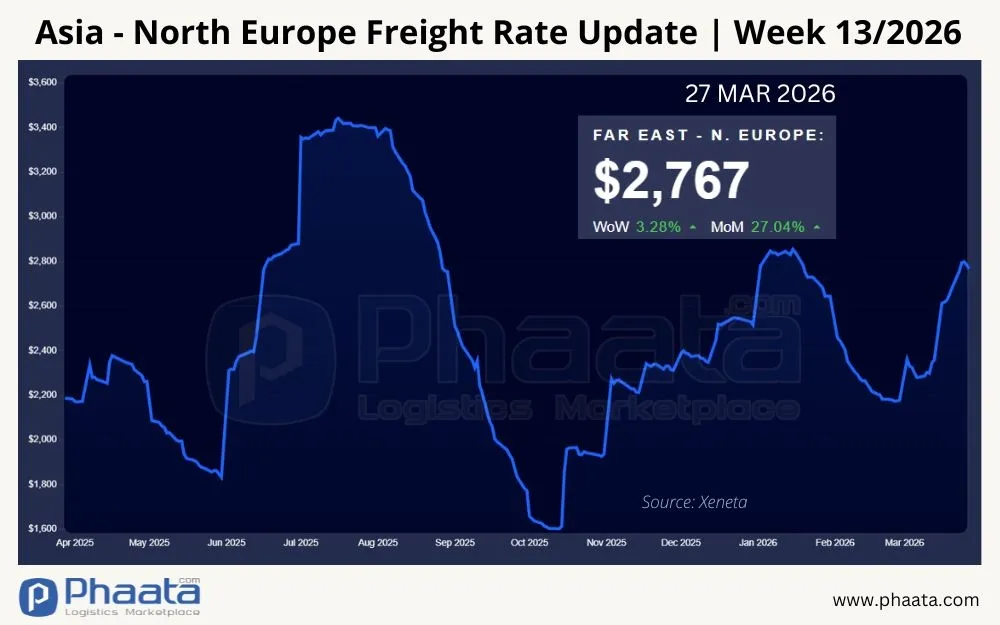
Asia-Europe Freight Rates | Week 13/2026 (Photo: Phaata.com)
4. North America - Asia Ocean Freight Rates
Ocean Freight rates from North America (West Coast) to Asia in Week 13/2026 continued to increase slightly by 0.68% week-on-week, up to $586/FEU. This rate is down 3.91% month-on-month, according to Xeneta data.
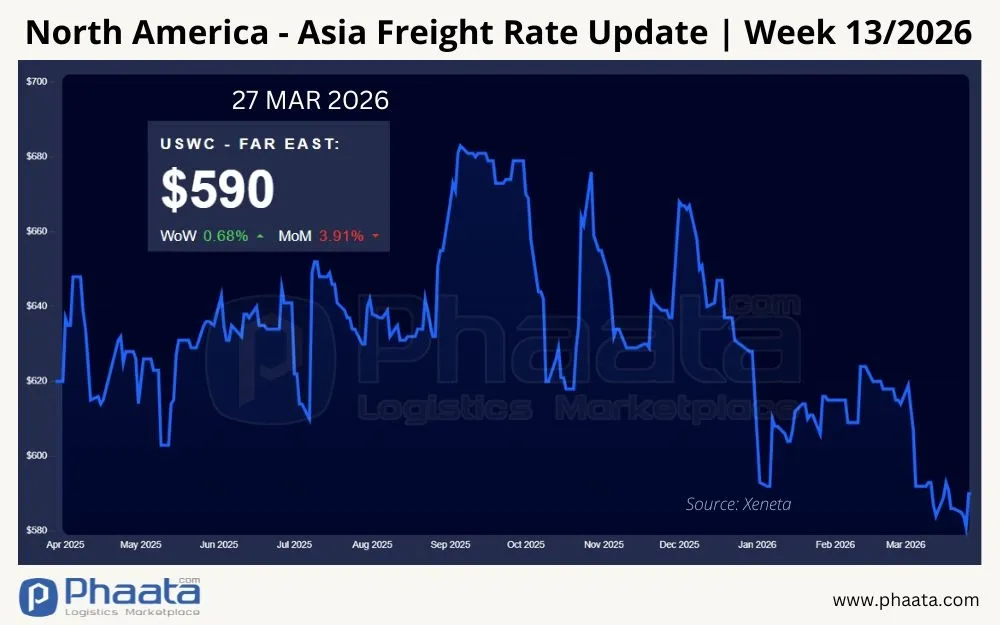
North America (West Coast) - Asia freight rates | Week 13/2026 (Photo: Phaata.com)
5. Northern Europe - Asia Ocean Freight Rates
Ocean Freight rates from North Europe to Asia in Week 13/2026 continued to surge sharply by 19.11% week-on-week, up to $187/FEU. This rate is up 33.57% month-on-month, per Xeneta data.
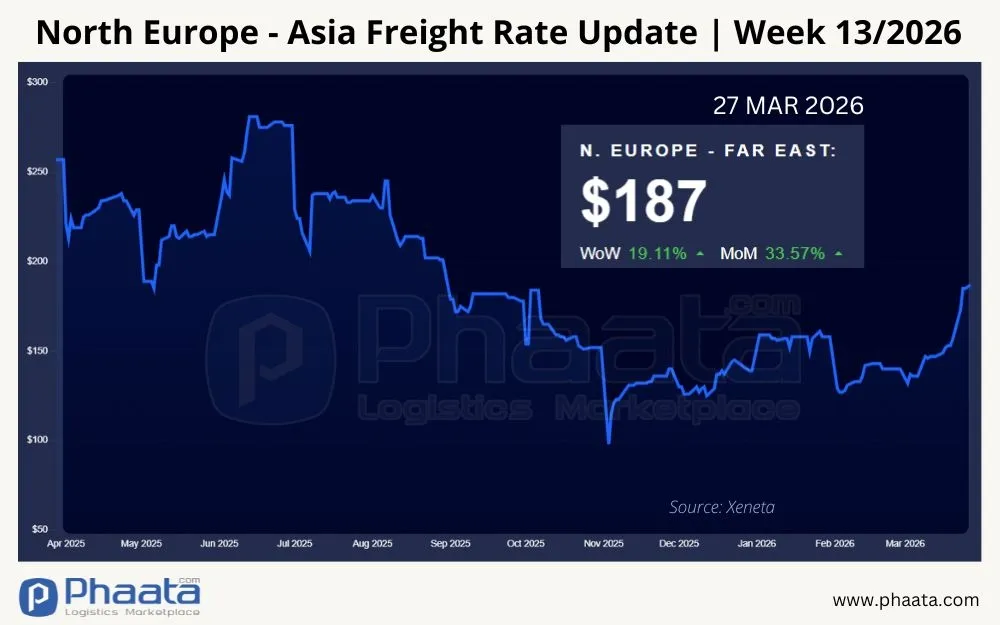
Container Freight rates from Northern Europe to Asia | Week 13/2026 (Photo: Phaata.com)
6. Conclusion and Recommendations from Phaata
The global logistics market in Week 13 has established a state of "technical rate increases." Current freight rate hikes are completely decoupled from natural supply-demand laws, driven instead by three direct intervention factors:
Price-Squeezing Tactics Ahead of Q2 Contracts: Despite low export volumes, Asia-North America rates still surged nearly 14% in a single week. This is a direct result of carriers uniformly applying dual fuel surcharges (EFS, IFS) combined with plans to withdraw 6-10% of capacity (blank sailings) in April to lock in the highest possible price floor ahead of the long-term contract negotiation season.
Localized Infrastructure Crises: Ceiling-level yard utilization (85-95%) at key ports (Singapore, Rotterdam, Hamburg) and extended vessel turnarounds around the Cape of Good Hope are breaking the equipment turnaround cycle. A shortage of empty containers in Asia has begun to materialize.
Risk of Ceiling-Level US Customs Costs: Delays in the IEEPA refund system (CAPE) place businesses at risk of missing protest deadlines. Simultaneously, the threat of the global tariff (Section 122) rising to 15% and the emergence of two Section 301 investigations aimed directly at Vietnam signal that the Landed Cost in the US market will spike sharply in Q2/2026.
Recommendations from Phaata
To protect profit margins and maintain cargo flows, businesses must heed the following:
1. On Transport and Rate Negotiation (Logistics & Procurement):
- Deconstruct Surcharge Structures During Negotiations: During Q2 long-term contract rate finalization sessions, absolutely do not accept "All-in rate" quotes that already include the Emergency Fuel Surcharge (EFS/EBS) and Intermodal Fuel Surcharge (IFS). Mandate that carriers separate these items into floating surcharges adjusted to actual oil prices, to avoid being anchored to peak freight rates.
- Shift Booking Tactics: Shift priority from "negotiating the cheapest rate" to "securing empty containers and vessel space." With a 6-10% blank sailing ratio in April, the documentation department must send Forecasts and lock in bookings at least 3-4 weeks in advance for North America and Europe routes.
- Relax Estimated Lead Times: Add 10 to 14 days to the committed schedule on foreign trade contracts for shipments transshipping via Singapore or discharging at Rotterdam/Hamburg to offset the risk of delays and port congestion.
2. On Customs and Finance (for the US Market):
- File Emergency Protests: Stop waiting for CBP's automated CAPE system. Direct your customs broker to audit and immediately file Protests for all IEEPA entries (including newly added Indian and Brazilian goods). This is the only legal maneuver to block automatic liquidation after 180 days and preserve the right to receive a refund.
- Update Cost of Goods Sold (COGS) Formula: Require the finance/accounting department to incorporate the scenario of a Section 122 tariff at the 15% ceiling into Landed Cost spreadsheets to safely price sales for shipments delivered in April and May.
- Prepare Section 301 Defense Files: Because Vietnam is on the dual investigation list (forced labor and overcapacity), the internal control department must immediately collect, digitize, and archive all Bill of Materials (BOM), origin traceability documents, and labor payrolls. This file must be ready to present within 24 hours upon request from US import partners or investigating agencies.
Stay tuned to articles on Phaata.com or Phaata fanpage for rapid and in-depth market updates.
Find Freight Rates Here
Find Logistics Companies Here
See more:
- Hapag-Lloyd Announces General Rate Increase (GRI) on South America Route
- CMA CGM Implements Peak Season Surcharges on Mauritius and West Africa Routes
- COSCO SHIPPING Resumes Bookings to the Middle East via Multimodal Transport Network
- Strategic Port of Salalah (Oman) Suspends Operations Following UAV Attack
- EUNAVFOR ASPIDES Warning: Threat of Attacks on Commercial Shipping in the Red Sea Shows Signs of Escalation
- Geopolitical 'Undercurrents' and the Restructuring Race Reshaping the Global Shipping Map
- SITC updates Vietnam-Intra Asia sailing schedules in Apr 2026
- Despite Airspace Risks, Qatar Cargo Resumes Dedicated Freighter Flights from Doha
- COSCO Shipping in 2025: Container Volumes Rise 6% as Digitalization and Green Fleet Expansion Accelerate
- Dubai Aviation: Sustaining Supply Chains Amidst the Middle East Geopolitical Storm
- COSCO schedules: Vietnam - North America in Mar 2026
Source: Phaata - Vietnam's First International Logistics Marketplace
► Find Better Freight Rates & Logistics Service Providers!


Featured News
- Hapag-Lloyd applies Peak Season Surcharge from East Asia to USA and Canada
- The world\'s largest container ships MSC Irina and MSC Loreto floated
- MSC (Mediterranean Shipping Company) - The world\'s leading container shipping lines
- Information you need to know about Maersk Line
- Top 10 export and import goods between Vietnam - Philippines in the first 5 months of 2020

 Market News
See more


_-_Copy.webp)
.webp)

 HOT PROMO
See more
4
 FCL
FCL
 39 Days
 Freight cost

Savino Del Bene
10
FCL
35 Days
Freight cost

OPL LOGISTICS
821
FCL
2 Days
Freight cost

CÔNG TY TNHH PIO LOGISTICS
1729
FCL
31 Days
Freight cost

CÔNG TY TRÁCH NHIỆM HỮU HẠN DT LOGISTICS (VN)
2783
FCL
30 Days
Freight cost

CÔNG TY TNHH PEGASHIP
Why do thousands of businesses trust Phaata?
USERS/MONTH
LOGISTICS COMPANIES
REQUEST FOR QUOTEŚ
QUOTATIONS
VIETNAM LOGISTICS COMMUNITY
5 Steps to Get the Best Quote
Find a price quickly/Send a RFQ
Compare multiple options
Contact for Further Consultation
Negotiating prices/services
Management & rating
 Freight rates
Sea freight
- FCL
See more
3
16
Days Direct
- ₫58,218,600 / 20'GP

CHI NHÁNH THÀNH PHỒ HỒ CHÍ MINH - CÔNG TY TNHH HECNY SHIPPING VIỆT NAM
23
40
Days Direct
- ₫196,223,145 / 20'GP
- ₫229,301,895 / 40'GP
- ₫229,301,895 / 40'HQ

ALLIANCE INTERNATIONAL LOGISTICS CO., LTD
 Premium
240
Premium
240
 259
22
Days Direct
259
22
Days Direct
- ₫179,948,400 / 40'RQ

CÔNG TY CỔ PHẦN QUỐC TẾ ANVY
251
13
Days Direct
- ₫75,419,550 / 40'RQ

CÔNG TY TNHH VẬN CHUYỂN QUỐC TẾ RYLOGS
Sea freight
- LCL
See more
637
7
Days Direct
- ₫105,852 /cbm

Công ty Cổ phần vận tải xuyên đại dương OVC
3,226
4
Days Direct
- ₫26,463 /cbm

CÔNG TY TNHH IEC EXPRESS (VIỆT NAM)- CHI NHÁNH HÀ NỘI
4,288
5
Days Direct
- ₫26,463 /cbm

CHI NHÁNH TẠI THÀNH PHỐ HỒ CHÍ MINH - CÔNG TY CỔ PHẦN MG LOGISTICS
4,704
8
Days Direct
- Refund ₫2,362,500 /cbm

CÔNG TY CỔ PHẦN TIẾP VẬN INTERCARGO
4,916
4
Days Direct
- ₫26,463 /cbm

CÔNG TY CỔ PHẦN GIAO NHẬN VẬN TẢI MỸ Á (ASL LOGISTICS)
 Air freight
- General cargo
Air freight
- General cargo
See more
1,765
10
Days Transit
- 264,630 ₫/kg

Phoenix Logistics Vietnam - chi nhánh TP. Hồ Chí Minh (Phoenix International Forwarding Vietnam )
2,866
1
Days Direct
- 185,241 ₫/kg

CÔNG TY TNHH THƯƠNG MẠI VÀ DỊCH VỤ FASTRANS
6,204
 5,772
8
Days Transit
5,772
8
Days Transit
- 224,936 ₫/kg

CÔNG TY TNHH SEA GLOBAL VIỆT NAM
3,161
1
Days Direct
- 502,797 ₫/kg

CÔNG TY TNHH VẬN TẢI QUỐC TẾ GIA PHÚ
 Rail freight
- FCL
Rail freight
- FCL
See more
43
5
Days Direct
- ₫44,987,100 / 40'HQ
- ₫44,987,100 / 45'HQ

CÔNG TY TNHH PHƯỚC TÁ
338
3
Days Direct
- ₫15,083,910 / 40'HQ

CÔNG TY CỔ PHẦN VẬN TẢI VÀ THƯƠNG MẠI ĐƯỜNG SẮT
11,301
7
Days Direct
- ₫48,956,550 / 20'GP

Công ty TNHH T&M Forwarding
10,526
5
Days Direct
- ₫7,145,010 / 20'GP

ASIAN EXPRESS LINE VIETNAM ( AEL VIET NAM )
8,532
10
Days Direct
- ₫9,262,050 / 20'GP

CÔNG TY CỔ PHẦN LOGISTICS QUỐC TẾ V&T
 Road freight
- FCL
Road freight
- FCL
See more
45
1
Day
- ₫28,000,000 / 20'GP
- ₫28,000,000 / 40'GP

CÔNG TY TNHH THƯƠNG MẠI DỊCH VỤ VÀ KHO VẬN VIETTEL POST - TTC
77
4
Day
- ₫211,704 / 20'GP

CÔNG TY CỔ PHẦN KINH DOANH THƯƠNG MẠI VÀ DỊCH VỤ HỎA TỐC
43,358
1
Day
- ₫6,868,686 / 20'OT
- ₫6,868,686 / 40'OT
- ₫6,868,686 / 40'OT HQ

CÔNG TY TNHH LIÊN VẬN QUỐC TẾ SHINING OCEAN VIỆT NAM
101,112
2
Day
- ₫6,500,000 / 40'RF
- ₫6,500,000 / 40'RQ
- ₫6,500,000 / 45'RQ

CÔNG TY CP PROSHIP
Premium
171,152
1
Day
- ₫18,997,200 / 20'GP
- ₫18,997,200 / 40'GP

CÔNG TY CỔ PHẦN GIAO NHẬN VẬN TẢI CON ONG


