


Saturday, 06/06/2026, 16:37 (GMT +7)
 1536
1536
Container Freight Rates on Asia–U.S. Trades Surge as Importers Rush Shipments Ahead of New Tariff Measures
.webp)
The transpacific container shipping market is experiencing a significant freight rate rally as U.S. importers move forward their purchasing and shipping schedules to mitigate the impact of anticipated tariff changes expected to take effect in July under Section 301 regulations.
This front-loading of imports is driving stronger demand on Asia–U.S. trade lanes while placing additional pressure on shipping capacity already affected by global supply chain disruptions and geopolitical tensions in the Middle East.
Asia–U.S. Freight Rates Jump by More Than 30%
According to Drewry, container freight rates from Shanghai to Los Angeles increased by 31% in a single week, while rates from Shanghai to New York rose by 20%.
Drewry noted that demand is being supported by a wave of early bookings from shippers seeking to avoid potential changes to U.S. import tariff policies in the coming months.
Drewry commented: "Carriers successfully implemented peak season surcharges on the transpacific eastbound trade route starting this month. With peak season now underway and seasonal demand strengthening through June, Drewry expects further upwards pressure on rates in the coming weeks."
Current freight rates tracked by Drewry are now nearly double the levels recorded before the escalation of the U.S.–Iran conflict.
Xeneta: Port Congestion and the Hormuz Crisis Are Driving Rate Increases
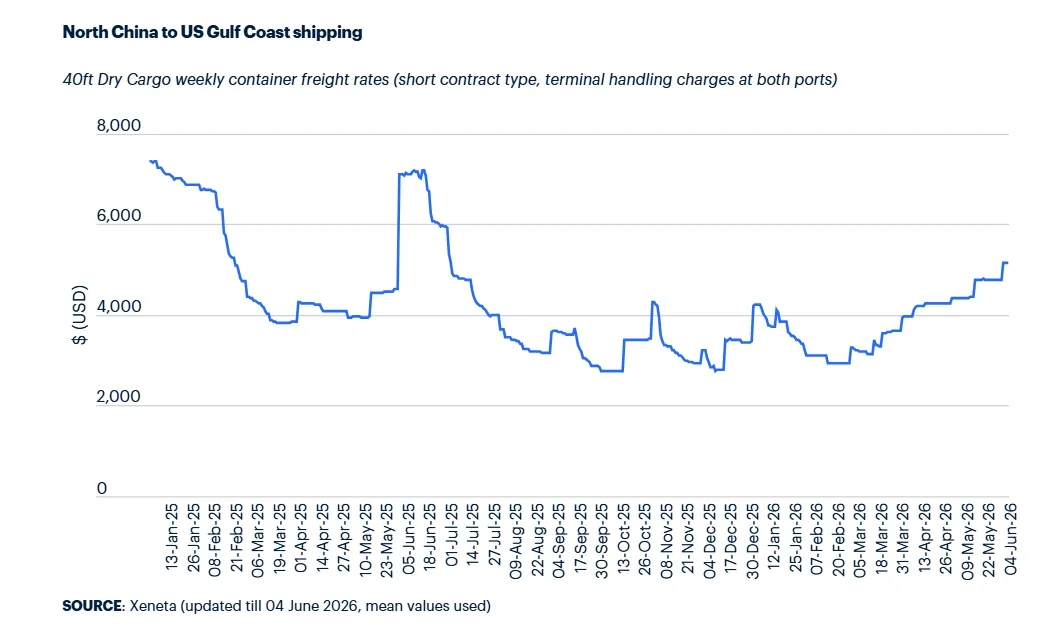
Data from Xeneta also indicates a clear upward trend in freight rates on Asia–U.S. routes.
Freight rates to the U.S. West Coast have increased by approximately 20%, while rates to the East Coast have climbed nearly 17%.
Peter Sand, Chief Analyst at Xeneta, believes the current rate surge is being driven by multiple factors simultaneously affecting global supply chains.
According to Sand:"The freight rate increases are partly due to delays at major southeast Asia ports including Singapore and Port Klang as services adjust to new networks and workarounds in response to the Strait of Hormuz blockade."
He added that disruptions at major transshipment hubs are now spreading across the broader container shipping network.
"Port disruption is toxic for supply chains, especially at transshipments hubs with global significance in southeast Asia, so this is driving massive market spikes on trades such as the transpacific which does not transit the Middle East."
Beyond port congestion, concerns over a potential energy crisis are also influencing shipper behavior.
Sand noted: "The prospect of an energy crisis caused by the Strait of Hormuz blockade and increasing oil prices may be enticing shippers to bring imports forward if they face higher manufacturing costs and higher freight rates later in the year."
He further warned: "If shippers do look to frontload imports, then carriers will look to push rates higher and higher, so the market may yet be far from its peak across trades globally."
Vespucci Maritime: The Red Sea Crisis Remains the Fundamental Driver
While many market observers attribute the latest freight rate escalation directly to the closure of the Strait of Hormuz, Lars Jensen, President of Vespucci Maritime, offers a different perspective.
According to Jensen: "It is not the blockage of the Strait of Hormuz itself which is causing this tightness."
He argues that the Hormuz crisis is indirectly prolonging the effects of the Red Sea disruption.
"However, the Hormuz crisis is the reason why the Red Sea crisis is not resolved. It is the detour around Africa due to the Red Sea crisis which continues to absorb a large amount of vessel capacity. Keep in mind that prior to the Hormuz Crisis we were beginning to see a slow reversal back to the Suez routing."
Citing data from Lloyd’s List Intelligence, Jensen noted that approximately 40 vessels have departed the Persian Gulf over the past three weeks under coordination with the U.S. Navy.
Importers Accept Higher Costs to Secure Supply
Data from Freight Right Logistics shows that freight rates to the U.S. West Coast have increased by nearly 40%, while rates to the East Coast have risen by approximately 30%.
Robert Khachatryan, Founder and CEO of Freight Right Logistics, stated that many companies are prioritizing supply security over transportation cost optimization.
He explained: "Importers with hard seasonal requirements, specifically those handling summer peak retail products and hospitality supply chains, are aggressively pushing cargo forward regardless of price premiums, inflating short-term demand. "
Industry analysts believe that this wave of front-loaded imports is placing additional pressure on available shipping capacity and continues to support higher freight rates across Asia–U.S. trade lanes.
Freight Indices Continue to Move Higher
The upward trend is also reflected across major container shipping indices.
The New York Shipping Exchange Freight Index (NYFI) increased by 5.9% on U.S. West Coast routes and by 2.7% on East Coast routes.
Meanwhile, the Shanghai Containerized Freight Index (SCFI) gained another 6% and now stands at nearly double the level recorded before the outbreak of the U.S.–Iran conflict.
These developments indicate that freight rate increases are not limited to the spot market but are now broadly reflected across key industry benchmark indices.
Chemical Tanker Market Shows Signs of Softening
In contrast to the container sector, freight rates in the liquid chemical tanker market edged lower over the past week.
According to ICIS, freight levels from the U.S. Gulf generally softened as demand remained insufficient to absorb available vessel supply.
Trade routes to Rotterdam, Asia, and South America continued to experience relatively subdued activity, although cargo inquiries for methanol, caustic soda, ethanol, and monoethylene glycol (MEG) remained present in the market.
Meanwhile, marine fuel prices remained largely unchanged from the previous week despite ongoing volatility in global energy markets.
Upward Pressure on Freight Rates Remains Intact
Industry experts believe the global container shipping market is entering a new upward freight rate cycle, driven by a combination of factors including accelerated imports ahead of U.S. tariff changes, congestion at major Southeast Asian transshipment hubs, the prolonged Red Sea crisis, and ongoing uncertainties surrounding the Strait of Hormuz.
Should geopolitical disruptions and supply chain challenges persist in the coming months, container freight rates on Asia–U.S. trade lanes are likely to remain on an upward trajectory and could establish new pricing benchmarks during the second half of 2026.
See more:
- MSC Restores Transpacific Pearl Service on the Asia–North America Trade Lane
- Hapag-Lloyd Discontinues CCM Service Connecting Mexico and Central America from July 2026
- COSCO Orders Four LNG Carriers Worth USD 953 Million to Expand LNG Fleet
- Dry Bulk Shipping Market: Capesize Leads the Rally
- International Shipping and Logistics Market Update Week 22/2026 | Phaata
- Global Container Shipping Schedule Reliability Reaches Highest Level of 2026 So Far
- Global Container Freight Rates Face Renewed Upward Pressure
- WorldACD Report: Global Air Cargo Volumes and Rates Slowly Establish a New Equilibrium
- Sea-Intelligence Q1 2026 Report: Ocean Carriers' Operating Profits Decline Sharply Under Freight Rate Pressure
- COSCO SHIPPING North America Named AgTC’s 2026 Recognized Ocean Carrier
- COSCO schedules: Vietnam - North America in Jun 2026
- COSCO updates Vietnam-Intra Asia sailing schedules in Jun 2026
- COSCO updates Vietnam-North Europe sailing schedules in Jun 2026
- SITC updates Vietnam-Intra Asia sailing schedules in Jun 2026
Source: Phaata.com (According to ICIS)
► Find Better Freight Rates & Logistics Service Providers!


Featured News
- Hapag-Lloyd applies Peak Season Surcharge from East Asia to USA and Canada
- The world\'s largest container ships MSC Irina and MSC Loreto floated
- MSC (Mediterranean Shipping Company) - The world\'s leading container shipping lines
- Information you need to know about Maersk Line
- Top 10 export and import goods between Vietnam - Philippines in the first 5 months of 2020

 Market News
See more

_-_Copy.webp)
.webp)
.webp)

 HOT PROMO
See more
10
 FCL
FCL
 2 Days
 Freight cost

CÔNG TY TNHH PIO LOGISTICS
652
FCL
31 Days
Freight cost

CÔNG TY TRÁCH NHIỆM HỮU HẠN DT LOGISTICS (VN)
1726
FCL
30 Days
Freight cost

CÔNG TY TNHH PEGASHIP
3462
FCL
45 Days
Freight cost

Compass Logistics
 Premium
5036
FCL
30 Days
Freight cost
Premium
5036
FCL
30 Days
Freight cost

CÔNG TY TNHH INTERNATIONAL LOGISTICS GLORY (VIỆT NAM)
Why do thousands of businesses trust Phaata?
USERS/MONTH
LOGISTICS COMPANIES
REQUEST FOR QUOTEŚ
QUOTATIONS
VIETNAM LOGISTICS COMMUNITY
5 Steps to Get the Best Quote
Find a price quickly/Send a RFQ
Compare multiple options
Contact for Further Consultation
Negotiating prices/services
Management & rating
 Freight rates
Sea freight
- FCL
See more
20
26
Days Direct
- ₫149,251,320 / 20'GP
- ₫185,241,000 / 40'GP
- ₫185,241,000 / 40'HQ

CÔNG TY TNHH TIẾP VẬN TOÀN CẦU KM
221
5
Days Direct
- ₫22,493,550 / 20'GP
- ₫44,987,100 / 40'HQ

CÔNG TY TNHH NGUYÊN ĐĂNG VIỆT NAM
347
10
Days Direct
- ₫46,310,250 / 40'HQ
CÔNG TY TNHH INTERNATIONAL LOGISTICS GLORY (VIỆT NAM)
387
4
Days Direct
- ₫529,260 / 20'GP
CÔNG TY TRÁCH NHIỆM HỮU HẠN DT LOGISTICS (VN)
436

Sea freight
- LCL
See more
435
7
Days Direct
- ₫105,852 /cbm

Công ty Cổ phần vận tải xuyên đại dương OVC
2,916
4
Days Direct
- ₫26,463 /cbm

CÔNG TY TNHH IEC EXPRESS (VIỆT NAM)- CHI NHÁNH HÀ NỘI
3,995
5
Days Direct
- ₫26,463 /cbm

CHI NHÁNH TẠI THÀNH PHỐ HỒ CHÍ MINH - CÔNG TY CỔ PHẦN MG LOGISTICS
4,448
8
Days Direct
- Refund ₫2,362,500 /cbm

CÔNG TY CỔ PHẦN TIẾP VẬN INTERCARGO
4,762
4
Days Direct
- ₫26,463 /cbm

CÔNG TY CỔ PHẦN GIAO NHẬN VẬN TẢI MỸ Á (ASL LOGISTICS)
 Air freight
- General cargo
Air freight
- General cargo
See more
1,603
10
Days Transit
- 264,630 ₫/kg

Phoenix Logistics Vietnam - chi nhánh TP. Hồ Chí Minh (Phoenix International Forwarding Vietnam )
2,635
1
Days Direct
- 185,241 ₫/kg

CÔNG TY TNHH THƯƠNG MẠI VÀ DỊCH VỤ FASTRANS
5,990
 5,572
8
Days Transit
5,572
8
Days Transit
- 224,936 ₫/kg

CÔNG TY TNHH SEA GLOBAL VIỆT NAM
3,053
1
Days Direct
- 502,797 ₫/kg

CÔNG TY TNHH VẬN TẢI QUỐC TẾ GIA PHÚ
 Rail freight
- FCL
Rail freight
- FCL
See more
163
3
Days Direct
- ₫15,083,910 / 40'HQ

CÔNG TY CỔ PHẦN VẬN TẢI VÀ THƯƠNG MẠI ĐƯỜNG SẮT
1,499
5
Days Direct
- ₫26,463,000 / 40'HQ
- ₫26,463,000 / 45'HQ

CÔNG TY TNHH PHƯỚC TÁ
11,099
7
Days Direct
- ₫48,956,550 / 20'GP

Công ty TNHH T&M Forwarding
10,348
5
Days Direct
- ₫7,145,010 / 20'GP

ASIAN EXPRESS LINE VIETNAM ( AEL VIET NAM )
8,439
10
Days Direct
- ₫9,262,050 / 20'GP

CÔNG TY CỔ PHẦN LOGISTICS QUỐC TẾ V&T
 Road freight
- FCL
Road freight
- FCL
See more
43,169
1
Day
- ₫6,868,686 / 20'OT
- ₫6,868,686 / 40'OT
- ₫6,868,686 / 40'OT HQ

CÔNG TY TNHH LIÊN VẬN QUỐC TẾ SHINING OCEAN VIỆT NAM
100,857
2
Day
- ₫6,500,000 / 40'RF
- ₫6,500,000 / 40'RQ
- ₫6,500,000 / 45'RQ

CÔNG TY CP PROSHIP
Premium
170,965
1
Day
- ₫18,997,200 / 20'GP
- ₫18,997,200 / 40'GP

CÔNG TY CỔ PHẦN GIAO NHẬN VẬN TẢI CON ONG
263,208
3
Day
- ₫32,000,000 / 20'GP
- ₫64,000,000 / 40'GP
- ₫64,000,000 / 40'HQ
- ₫64,000,000 / 45'HQ

Công ty Cổ phần phát triển thương mại Thuận Đạt Việt Nam
283,631


