


Monday, 12/10/2026, 09:36 (GMT +7)
 45
45
International Shipping and Logistics Market Update Week 41/2026 | Phaata
International shipping and logistics market update - Week 40/2026
Table of Contents
-
World Container Index Week 41/2026
-
Asia - North America Ocean Freight Rates
-
Asia - Europe Ocean Freight Rates
-
Northern America - Asia Ocean Freight Rates
-
Northern Europe - Asia Ocean Freight Rates
-
Conclusions and Recommendations by Phaata
1. World Container Index Week 41/2026
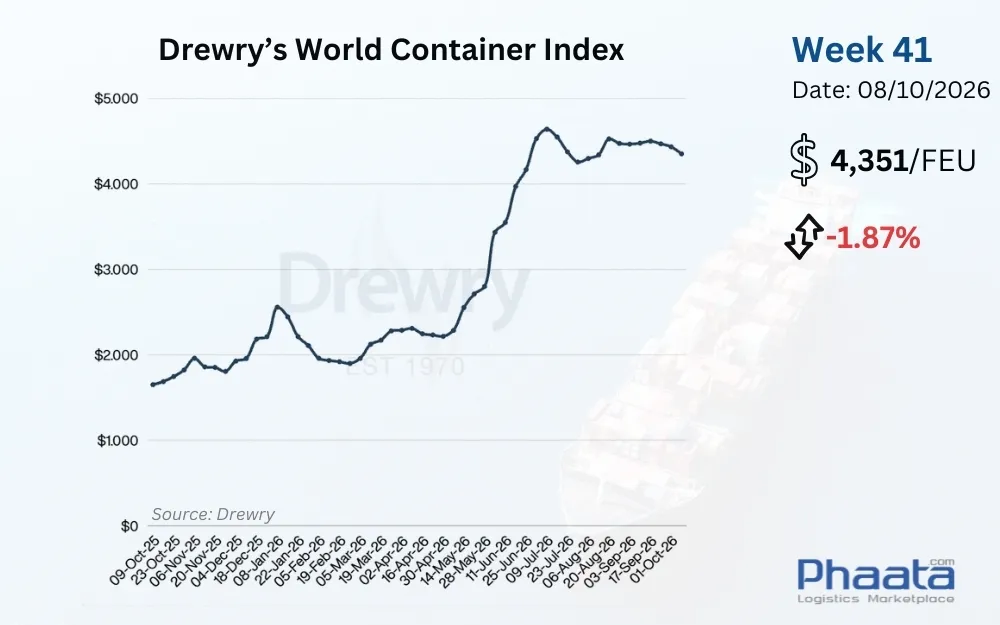
Drewry’s World Container Index (WCI) for Week 41/2026 (from October 5 to October 11, 2026) decreased by 1.87% compared to the previous week, dropping to $4,351/FEU.
Drewry's World Container Index Week 41/2026 (Photo: Phaata)
2. Asia-North America Ocean Freight Rates
Supply and Demand:
Capacity Adjustments During Golden Week: In Week 41, coinciding with China's Golden Week holiday, carriers intensified their blank sailing programs to align capacity with fluctuating cargo volumes. Overall, however, the design capacity deployed on the trade lane remains significantly higher than during the same periods in previous years.
Port Omissions and Schedule Impacts at Shanghai: Congestion at several Asian loading ports has shown signs of easing. Nevertheless, carriers continue to adjust port rotations through port omissions to improve schedule reliability. The Shanghai port cluster continues to experience significant volatility, with port omissions previously exceeding 10 per week during September.
Holiday Export Volumes and Recovery Prospects: The Golden Week holiday (October 1–7) may trigger a short-term dip in export volumes. Post-holiday, demand is expected to recover gradually, shaping volume trends on the route through mid-November.
Rate Developments:
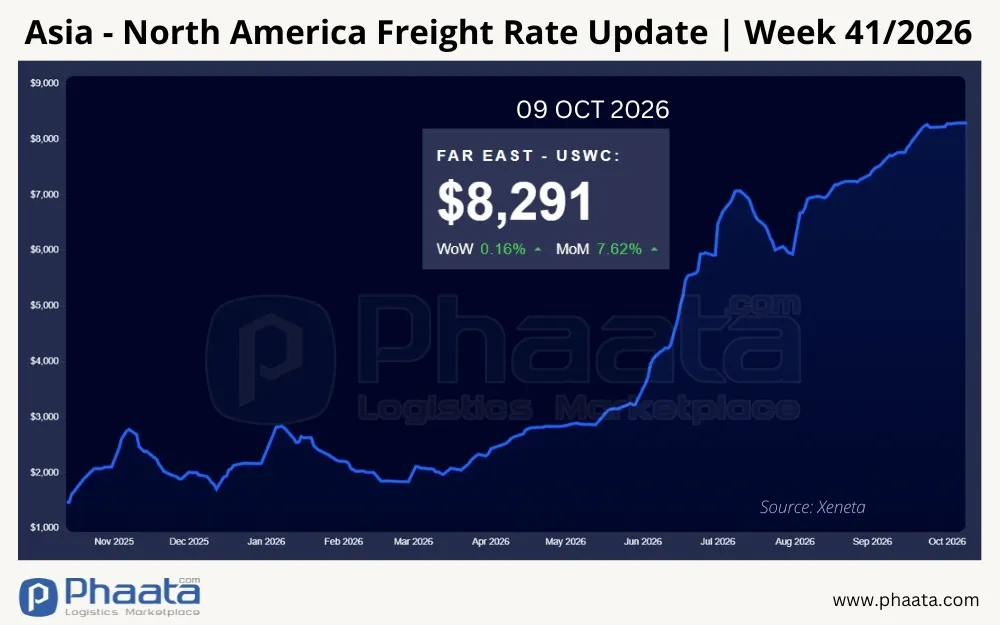
Ocean freight rates from Asia to the North America West Coast in Week 41/2026 increased slightly by 0.16% week-on-week, settling at $8,291/FEU. This rate is up 7.62% month-on-month, according to Xeneta data.
Rate Baseline Shows Signs of Stabilization: Amid slowing export activities around the Golden Week holiday, the rate baseline on the route is trending sideways. However, current rates remain elevated compared to the period prior to the outbreak of the Iran conflict. This trajectory indicates that transport costs remain a critical variable to account for in import-export planning.
Q4 Supply and Market Outlook: Following typical cyclical patterns, the maritime transport market may plateau before demand rebounds in the lead-up to the Lunar New Year. However, Q4 developments this year will heavily depend on carriers' capacity adjustment plans, port operational conditions, and the pace of demand recovery. Should schedule disruptions persist, actual capacity supply could face continued pressure.
Stay tuned to Phaata International Logistics Marketplace for in-depth and fast market updates.
Asia-North America Freight Rates | Week 41/2026 (Photo: Phaata.com)
US Tariff Updates:
1. CAPE Refund System Rolls Out Phase 3
-
System Operations: U.S. Customs and Border Protection (CBP) opened the portal for Phase 3 of the CAPE (Consolidated Administration and Processing of Entries) system at 5:10 AM EST on October 6. On its launch day, the system received 477 entry submissions.
-
Applicability Criteria: The criteria for Phase 3 participation remain unchanged. This process applies to entries slated for reliquidation pursuant to court rulings. Importers must also possess a valid Importer of Record (IOR) number registered in the CBP system prior to July 30.
-
Scope of Follow-on Protests: Reliquidation via CAPE does not imply a comprehensive review of the original entry. According to process guidelines, follow-on protests are strictly limited to matters within the scope of the reliquidation. Consequently, protest claims unrelated to this process may fall outside the scope of review for the file.
2. Debate Over the Jurisdiction of the U.S. Court of International Trade (CIT)
-
Core Arguments: The U.S. Supreme Court’s CASA ruling raised questions regarding the jurisdictional scope of federal courts in issuing remedies benefiting non-parties to a lawsuit. Current debates center on whether this limitation applies to the U.S. Court of International Trade (CIT). The U.S. Government argues that the aforementioned limitation indeed applies to the CIT. Conversely, a coalition of importers, including V.O.S. Selections, argued in an October 5 filing that the CIT possesses specialized, nationwide jurisdiction over trade matters and can issue remedies with a broader scope than just the direct plaintiffs.
-
Potential Impact on Importers: If the U.S. Government's stance is upheld, some importers affected by tariffs under the International Emergency Economic Powers Act (IEEPA) may need to file individual lawsuits to seek redress. Conversely, if the importers' arguments prevail, CIT rulings could have a broader application, potentially paving the way for non-litigating importers to benefit. The actual outcome will hinge on the court's decision and the applied scope of individual rulings.
3. USMCA Review Amid Shifting Tariff Policies
-
Trade Policy Developments: Several Washington-based policy analysts, including the Council on Foreign Relations (CFR), have highlighted the divergence between U.S. diplomatic messaging toward Canada and Mexico and the actual application of tariff measures on goods from these partners. Tariff developments continue to be a focal point in North American trade relations.
-
Impact on the USMCA Review: In 2026, several Canadian commodity groups - including motor vehicles, alcoholic beverages, dairy products, and steel-related products - are impacted by shifting U.S. tariff policies. These developments unfold ahead of the six-year periodic review of the United States-Mexico-Canada Agreement (USMCA), as parties continue to deliberate on trade and enforcement issues within the agreement.
-
Note on Tariff Preferences: For goods imported and exported under the USMCA, satisfying rules of origin is the prerequisite for claiming preferential treatment. However, this preference does not exempt goods from all other U.S. tariff measures. Businesses must clearly distinguish between USMCA preferential duty rates and additional tariffs, exceptions, or import restrictions applied specifically to certain commodity groups.
Stay tuned to articles on the Phaata International Logistics Marketplace for rapid and in-depth market updates.
3. Asia-Europe Ocean Freight Rates
Supply and Demand:
High Operational Capacity Maintained: In Week 41, capacity on the Far East - Westbound (FEWB) route continued to be maintained at a high level. The blank sailing ratio was recorded at approximately 1.1%. Based on current forecast data, carriers have no planned blank sailings for the week commencing October 12.
Capacity Adjustment Plans from Late October: From the week commencing October 19, operational plans are expected to undergo more pronounced adjustments. The blank sailing ratio is forecast to surge to around 10.7–12.9% by early November. This suggests carriers may intensify capacity regulation as transport demand shows signs of stalling.
Signs of Cooling Demand: Export cargo volumes are exhibiting signs of cooling. In this context, capacity adjustments may reflect efforts to balance supply with market demand. However, further cross-referencing with cargo volume and booking data is required to determine whether these voyage cuts stem primarily from weakening demand or other operational factors.
Impact of the Return to the Suez Canal Routing:
Carriers Gradually Restore Suez Routings: Several major carriers, including CMA CGM, Maersk, MSC, and Hapag-Lloyd, have progressively reintroduced a portion of their services to the Suez Canal routing. COSCO/OOCL are also among the carriers mentioned in reports regarding routing adjustments. The pace of this return varies by carrier and specific service.
Premier Alliance Announces Suez Return: The Premier Alliance—comprising ONE, HMM, and Yang Ming—has also announced plans to shift its FE1 service (connecting Southeast Asia with North Europe) back to the Suez Canal routing. According to an early October announcement, the plan is scheduled for implementation between mid and late October, with the ONE Continuity slated as one of the first vessels on this resumed routing. This move marks a shift in the alliance's operational strategy following a period of utilizing the Cape of Good Hope detour.
Actual Capacity Supply May Increase: The Suez routing is shorter than the Cape of Good Hope detour, reducing transit times and potentially improving vessel turnarounds. As services transition back to this route, the number of days required to complete a rotation could decrease, thereby contributing to an increase in actual capacity supply on the Far East - Westbound route. The extent of this impact will depend on the number of services adjusted and the actual implementation pace.
Freight Rate Developments:
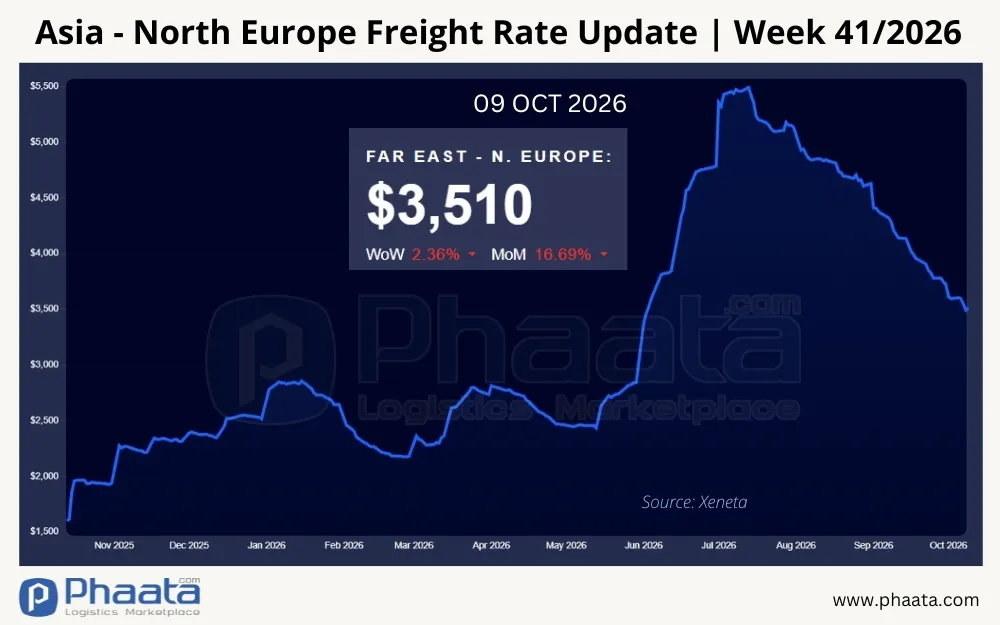
Ocean freight rates from Asia to Europe in Week 41/2026 decreased by 2.36% week-on-week, dropping to $3,510/FEU. This rate is down 16.69% month-on-month, according to Xeneta data.
Spot Rates Remain Under Downward Pressure: Spot rates on the Asia-Europe route continue their downward trajectory following a sharp rally during the summer. The specific magnitude of the decline needs to be benchmarked against relevant indices, transport routes, and comparative timeframes to accurately reflect the dynamics of the North Europe and Mediterranean markets.
Potential for Rate Hikes in Late October: Carriers have announced plans to implement rate increases in late October. The viability of sustaining these new rate levels will depend on demand developments, capacity management strategies, and operational conditions on the route. The return of multiple services to the Suez Canal could inject additional capacity, potentially exerting further downward pressure on the rate baseline if demand fails to increase proportionately.
Stay tuned to Phaata International Logistics Marketplace for in-depth and fast market updates.
Asia-Europe Freight Rates | Week 41/2026 (Photo: Phaata.com)
4. North America - Asia Ocean Freight Rates
Ocean freight rates from North America (West Coast) to Asia in Week 41/2026 increased by 4.02% week-on-week, settling at $672/FEU. This rate is down 5.22% month-on-month, according to Xeneta data.
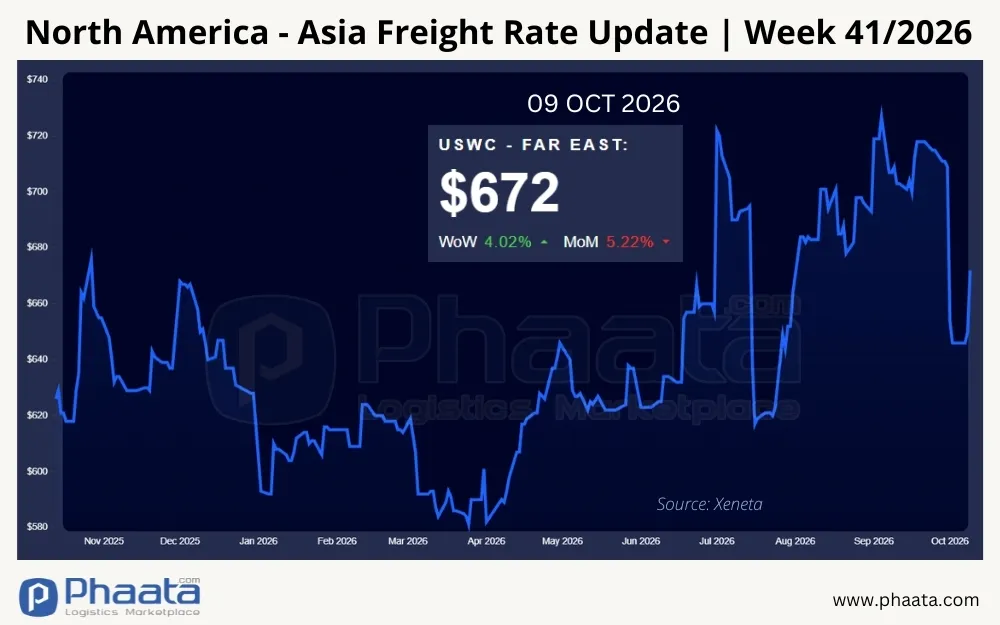
North America (West Coast) - Asia freight rates | Week 41/2026 (Photo: Phaata.com)
5. Northern Europe - Asia Ocean Freight Rates
Ocean freight rates from North Europe to Asia in Week 41/2026 increased by 4.02% week-on-week, reaching $233/FEU. This rate is up 2.64% month-on-month, per Xeneta data.
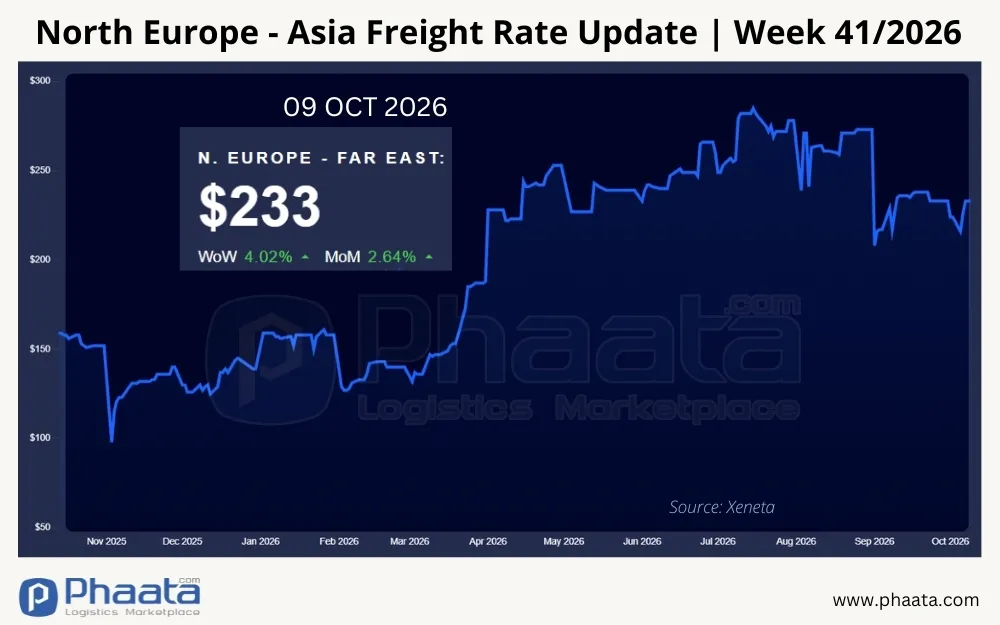
Container Freight rates from Northern Europe to Asia | Week 41/2026 (Photo: Phaata.com)
6. Conclusion and Recommendations from Phaata
In Week 41/2026, the WCI index dropped 1.87% to $4,351/FEU. This trend highlights the continued divergence in the container shipping market across major trade lanes, while policy and legal shifts in the U.S. remain critical factors to monitor.
Trans-Pacific Route (Asia - North America): During China's Golden Week, spot rates on the route still ticked up slightly by 0.16% to $8,291/FEU for the U.S. West Coast. The rate baseline remains elevated. Moving forward, the trajectory of U.S. import demand and schedule adjustments—including port omissions at hubs like Shanghai—will be key factors to monitor to assess actual capacity supply and transit times.
Far East - West Europe Route: Spot rates fell by 2.36% to $3,510/FEU, indicating that Asia-Europe rates remain under corrective pressure. Planned capacity cuts of 10.7–12.9% in early November could help carriers balance supply and demand. However, future rate developments will also depend on transport demand and the potential influx of capacity as select services, including those of the Premier Alliance, begin resuming transits via the Suez Canal.
U.S. Trade Policy: The deployment of Phase 3 of the CAPE system enables importers to meet criteria for executing refund procedures as regulated. Additionally, legal developments regarding the jurisdiction of the U.S. Court of International Trade (CIT) and the periodic review of the USMCA are issues businesses should continue to track to proactively assess impacts on import costs and compliance planning.
Recommendations from Phaata
Track Freight Rates and Maintain Flexible Transport Plans
-
North America Route: Businesses should consider multiple rate scenarios when budgeting for Q4/2026, factoring in the likelihood that the rate baseline will remain high. For shipments originating from Shanghai, incorporating a time buffer can enhance flexibility in the face of schedule changes or port omissions. Shippers may also consider booking early for post-Golden Week shipments, while securing space confirmations and departure schedules from carriers.
-
Far East - West Europe Route: For services transiting the Suez Canal, businesses should verify the actual operational routing, estimated transit times, and related conditions before confirming bookings. If blank sailing ratios surge in late October and early November as forecast, aligning port delivery schedules with carrier cut-offs and preparing contingency plans can mitigate the risk of cargo roll-overs.
Update Tax Policies and Finalize Relevant Documentation
-
Review CAPE Refund Eligibility: Importing businesses should review participation criteria, Importer of Record (IOR) status, and applicable timelines to determine their eligibility for refund processing via CAPE Phase 3. For cases requiring follow-on protests, reviewing the scope of the ruling and related documentation—combined with consulting legal experts or customs representatives as needed—will provide a stronger foundation for proper file preparation.
-
Monitor CIT Legal Developments: Businesses should continue tracking rulings related to the jurisdiction of the U.S. Court of International Trade and evaluate potential impacts on applicable tariffs, including IEEPA taxes if within scope. Depending on legal developments and specific case statuses, businesses can weigh appropriate strategies to protect their interests, as well as project the required resources and time for processing.
-
Update USMCA Origin Documentation: As the USMCA enters its periodic review phase, businesses leveraging North American tariff preferences should re-verify the completeness, consistency, and validity of their origin documentation. Monitoring shifts in U.S. tax policies on Canadian goods will also aid businesses in evaluating impacts on specific commodity groups. For items that may no longer qualify for preferences, businesses can explore alternative sourcing options and update cost planning as necessary.
Stay tuned to articles on Phaata.com or Phaata fanpage for rapid and in-depth market updates.
Find Freight Rates Here
Find Logistics Companies Here
See more:
- Ocean Shipping Disruptions and Tariff Uncertainties Drive Incremental Air Freight Demand in Q4
- MSC and ONE to Continue Ipanema Service Under New VSA from April 2027
- COSCO SHIPPING Holdings Expands Asia-Pacific Service Network
- COSCO updates Vietnam-Intra Asia sailing schedules in Oct 2026
- Around 12% of Global Containership Capacity Affected by Port Congestion
- International Shipping and Logistics Market Update Week 40/2026 | Phaata
- CMA CGM Completes $1.4 Billion Acquisition of FedEx Supply Chain
- Legend Cargo Logistics: Eight Years of Building Expertise and Trust on the Vietnam–North America Trade Lane
- COSCO schedules: Vietnam - North America in Oct 2026
- COSCO updates Vietnam-North Europe sailing schedules in Oct 2026
- SITC updates Vietnam-Intra Asia sailing schedules in Oct 2026
- Sea-Intelligence: Global Schedule Reliability Falls to Lowest Level Since 2022
- Hapag-Lloyd Steps Up Talks with Israel, Details Revised ZIM Proposal
- IATA Calls for Stronger Controls on Dangerous Goods Across the Air Cargo Supply Chain
Source: Phaata - Where Shippers & Logistics Providers Connect
► Find Better Freight Rates & Logistics Service Providers!


Featured News
- Hapag-Lloyd applies Peak Season Surcharge from East Asia to USA and Canada
- The world\'s largest container ships MSC Irina and MSC Loreto floated
- MSC (Mediterranean Shipping Company) - The world\'s leading container shipping lines
- Information you need to know about Maersk Line
- Top 10 export and import goods between Vietnam - Philippines in the first 5 months of 2020

 Market News
See more
.webp)
.webp)

.webp)

 HOT PROMO
See more
230
 FCL
FCL
 28 Days
 Freight cost

CÔNG TY TRÁCH NHIỆM HỮU HẠN DT LOGISTICS (VN)
757
FCL
28 Days
Freight cost

Công Ty TNHH Quanterm Logistics Vietnam
1006
FCL
33 Days
Freight cost

CÔNG TY TNHH TIẾP VẬN TOÀN CẦU KM
1109
 Other
Other

INTERLOG CORP - CÔNG TY CỔ PHẦN GIAO NHẬN TIẾP VẬN QUỐC TẾ
993
FCL
35 Days
Freight cost

CÔNG TY TNHH INTERNATIONAL LOGISTICS GLORY (VIỆT NAM)
Why do thousands of businesses trust Phaata?
USERS/MONTH
LOGISTICS COMPANIES
REQUEST FOR QUOTEŚ
QUOTATIONS
VIETNAM LOGISTICS COMMUNITY
5 Steps to Get the Best Quote
Find a price quickly/Send a RFQ
Compare multiple options
Contact for Further Consultation
Negotiating prices/services
Management & rating
 Freight rates
Sea freight
- FCL
See more
37
7
Days Direct
- ₫26,100,000 / 40'GP
- ₫26,100,000 / 40'HQ

CÔNG TY CỔ PHẦN TIẾP VẬN INTERCARGO
41
22
Days Transit
- ₫57,292,395 / 20'GP
- ₫111,806,175 / 40'GP
- ₫111,806,175 / 40'HQ
- ₫113,129,325 / 45'HQ

MELODY LOGISTICS COMPANY LIMITED
110
7
Days Transit
- ₫4,631,025 / 20'GP
- ₫10,585,200 / 40'HQ

GIA LINH LOGISTICS SERVICES CO., LTD. (G LINK Logistics)
636
28
Days Direct
- ₫76,345,755 / 20'GP
Công Ty TNHH Quanterm Logistics Vietnam
1,006
11
Days Direct
- ₫1,984,725 / 20'GP
- ₫3,043,245 / 40'HQ

Compass Logistics
 Premium
Sea freight
- LCL
See more
1,240
4
Days Direct
- ₫0 /cbm

CÔNG TY CỔ PHẦN GIAO NHẬN VẬN TẢI HỒNG SƠN
1,992
5
Days Direct
- ₫0 /cbm
CÔNG TY TRÁCH NHIỆM HỮU HẠN DT LOGISTICS (VN)
2,318
6
Days Direct
- ₫523,180 /cbm

CÔNG TY TNHH VẬN TẢI VÀ TIẾP VẬN TOÀN CẦU
2,450
 1,771
4
Days Direct
1,771
4
Days Direct
- ₫396,945 /cbm

CHI NHÁNH THÀNH PHỒ HỒ CHÍ MINH - CÔNG TY TNHH HECNY SHIPPING VIỆT NAM
 Air freight
- General cargo
Air freight
- General cargo
See more
471
1
Days Direct
- 46,310 ₫/kg

N.B.L INTERNATIONAL TRANSPORT CO., LTD
879
1
Days Direct
- 161,424 ₫/kg
CÔNG TY CỔ PHẦN GIAO NHẬN VẬN TẢI HỒNG SƠN
3,883
10
Days Transit
- 264,630 ₫/kg

Phoenix Logistics Vietnam - chi nhánh TP. Hồ Chí Minh (Phoenix International Forwarding Vietnam )
5,647
1
Days Direct
- 185,241 ₫/kg

CÔNG TY TNHH THƯƠNG MẠI VÀ DỊCH VỤ FASTRANS
8,421

 Rail freight
- FCL
Rail freight
- FCL
See more
1,866
5
Days Direct
- ₫44,987,100 / 40'HQ
- ₫44,987,100 / 45'HQ

CÔNG TY TNHH PHƯỚC TÁ
3,365
3
Days Direct
- ₫15,083,910 / 40'HQ

CÔNG TY CỔ PHẦN VẬN TẢI VÀ THƯƠNG MẠI ĐƯỜNG SẮT
13,853
7
Days Direct
- ₫48,956,550 / 20'GP

Công ty TNHH T&M Forwarding
12,666
5
Days Direct
- ₫7,145,010 / 20'GP

ASIAN EXPRESS LINE VIETNAM ( AEL VIET NAM )
9,506
10
Days Direct
- ₫9,262,050 / 20'GP

CÔNG TY CỔ PHẦN LOGISTICS QUỐC TẾ V&T
 Road freight
- FCL
Road freight
- FCL
See more
1,912
1
Day
- ₫28,000,000 / 20'GP
- ₫28,000,000 / 40'GP

CÔNG TY TNHH THƯƠNG MẠI DỊCH VỤ VÀ KHO VẬN VIETTEL POST - TTC
3,802
4
Day
- ₫211,704 / 20'GP

CÔNG TY CỔ PHẦN KINH DOANH THƯƠNG MẠI VÀ DỊCH VỤ HỎA TỐC
46,704
1
Day
- ₫6,868,686 / 20'OT
- ₫6,868,686 / 40'OT
- ₫6,868,686 / 40'OT HQ

CÔNG TY TNHH LIÊN VẬN QUỐC TẾ SHINING OCEAN VIỆT NAM
104,089
2
Day
- ₫6,500,000 / 40'RF
- ₫6,500,000 / 40'RQ
- ₫6,500,000 / 45'RQ

CÔNG TY CP PROSHIP
Premium
173,291
1
Day
- ₫18,997,200 / 20'GP
- ₫18,997,200 / 40'GP

CÔNG TY CỔ PHẦN GIAO NHẬN VẬN TẢI CON ONG


